How Are Businesses Really Valued? A Beginner’s Guide to Understanding Business Value
Business value is shaped by much more than revenue or profit. This foundation lesson explains what buyers actually look for, why similar businesses can have very different values, and how to think about valuation without getting lost in financial terminology.
Prefer watching instead of reading?
Watch the video version of this lesson for a simple, step-by-step explanation.
Lesson 1: Understanding Business Value
By the end of this lesson, you should understand what business valuation is, why revenue and profit never tell the full story, what experienced buyers examine before making an offer, and how the rest of this learning path fits together.
Imagine two businesses operating on the same street.
Both generate approximately $1 million in annual revenue. Both have been operating for more than ten years. Both appear profitable. From the outside, they look equally successful.
One receives several serious offers within a few weeks of being listed for sale.
The other remains on the market for almost a year.
Why?
Most people assume the answer must be revenue or profit.
That is understandable. Those are the numbers we hear about most often.
But experienced buyers rarely decide what a business is worth by looking at one financial number.
They want to know whether the earnings are dependable, whether the customers are likely to stay, whether the business can operate without the current owner, and how much risk they would inherit after the purchase.
In other words, they are not simply asking:
How much money does this business make today?
They are asking a much bigger question:
How confident can I be that this business will continue creating value after I become the owner?
That question sits at the heart of business valuation.
Valuation is not just a formula. It is not simply revenue multiplied by a number. And it is rarely one perfectly certain price that every buyer, seller, lender, or advisor will agree on.
It is a structured way of understanding the financial performance, risks, strengths, systems, customers, people, assets, and future potential of a business.
Throughout this learning path, we will explain concepts such as EBITDA, Seller’s Discretionary Earnings (SDE), cash flow, goodwill, working capital, add-backs, and valuation multiples.
But before learning those individual terms, it helps to understand the larger picture they are all trying to explain.
Let’s begin with what business valuation actually means, then look at the questions buyers use to judge whether a business feels valuable, risky, or somewhere in between.
What Is Business Valuation?
At its simplest, business valuation is the process of estimating what a business may be worth.
That sounds straightforward.
In practice, it is rarely as simple as entering a few numbers into a calculator and accepting the result.
A thoughtful valuation looks at the financial performance of the business, but it also considers the quality of those earnings, the risks attached to them, and how easily the business could continue under new ownership.
This is why two companies with similar revenue and profit can still receive very different valuations.
One may have recurring customers, documented systems, a strong management team, and steady growth.
The other may depend heavily on the owner, rely on one major customer, or require significant investment shortly after the sale.
The financial statements may look similar.
The ownership experience may be completely different.
Business valuation is not only about what the company earns.
It is also about how reliable, transferable, and sustainable those earnings appear to a buyer.
Is business valuation an exact science?
Not really.
Valuation uses financial analysis, market evidence, professional judgment, and assumptions about the future.
Different qualified people may review the same business and reach slightly different conclusions.
That does not automatically mean one of them is wrong.
They may be using different assumptions about growth, risk, market conditions, required investment, or the appropriate valuation multiple.
This is one reason a business valuation is often better understood as an estimated range rather than a single guaranteed selling price.
☕ Coffee Break
A valuation is an informed estimate of value.
A sale price is what a real buyer and seller eventually agree to under real market conditions.
Why Business Valuation Matters
Many owners only begin thinking about valuation when they are ready to sell.
By then, some of the biggest opportunities to improve value may already be difficult to address.
Understanding valuation earlier can change the way you operate the business.
It can help you see which parts of the company create confidence and which parts quietly create risk.
Business valuation can be useful when you are:
- Considering buying a business.
- Preparing to sell a business.
- Planning retirement or succession.
- Bringing in a partner or shareholder.
- Raising investment or applying for financing.
- Resolving an ownership dispute.
- Measuring whether the business is becoming stronger over time.
Even if you never plan to sell, thinking like a buyer can improve the business.
Buyers value organized financial records, capable teams, repeatable processes, loyal customers, and earnings that do not disappear when the owner takes a vacation.
Those are not only exit-planning improvements.
They usually make the business easier to operate today.
For owners wondering where to begin, our guide on how much a small business may be worth explains why financial results are only one part of the valuation conversation.
The Three Questions Every Buyer Is Really Asking
Business valuation can become technical very quickly.
There are formulas, multiples, adjustments, financial statements, market comparisons, and industry-specific methods.
Underneath all of that, most buyers are trying to answer three basic questions.
1. Can this business make money?
The first question is about profitability.
Buyers want to understand revenue, expenses, margins, cash flow, EBITDA, SDE, and whether the financial records accurately reflect normal operations.
A business may generate impressive sales and still produce very little profit.
Another may have lower revenue but stronger margins and much healthier cash flow.
Revenue alone does not answer the question.
2. Can it keep making money?
This is the risk question.
Buyers look at whether the earnings are stable, recurring, and likely to continue.
They may examine customer concentration, industry trends, competition, supplier dependency, employee retention, contracts, seasonality, equipment condition, and the consistency of historical results.
A profitable business can still be risky if one customer, employee, supplier, or contract controls too much of its future.
3. Can someone else successfully own it?
This is the transferability question.
Buyers want to know whether the business is truly a company or mainly a job built around the current owner.
If the owner handles every sale, remembers every process, controls every relationship, and solves every problem, a buyer may struggle to take over.
A transferable business has systems, records, people, and processes that allow value to survive the change in ownership.
Most business valuation questions eventually come back to profitability, risk, and transferability.
🧠 Did You Know?
A business with slightly lower profit can sometimes attract a higher valuation multiple if its earnings are more predictable and the company is easier to transfer.
This is why what buyers look for before buying a small business extends far beyond a single calculation.
What Actually Creates Business Value?
If business valuation were based only on revenue or profit, valuing a company would be easy.
But experienced buyers know that financial performance is only part of the picture.
They are buying the future of the business, not just its past financial statements.
That means they want to understand what makes the business reliable, sustainable, and capable of continuing to perform after ownership changes.
While every business is different, there are several factors that commonly influence value.
| Factor | Why It Matters |
|---|---|
| Revenue | Shows the scale of the business. |
| Profitability | Shows whether the business generates healthy earnings. |
| Cash Flow | Shows whether the business can fund its operations. |
| Recurring Revenue | Provides greater confidence in future earnings. |
| Customer Base | Diversified customers generally reduce risk. |
| Management Team | A capable team reduces dependence on the owner. |
| Systems & Processes | Well-documented operations improve transferability. |
| Industry Outlook | Future opportunities and risks influence value. |
| Growth Potential | Businesses with room to grow often attract stronger interest. |
None of these factors determines value on its own.
Together, they help build confidence in the future performance of the business.
Buyers are not simply buying today’s earnings.
They are buying confidence in tomorrow’s earnings.
☕ Coffee Break
Think of business valuation like assembling a puzzle.
Revenue, profit, cash flow, customers, employees, systems, and growth are all individual pieces.
Looking at only one piece rarely shows the complete picture.
Why Profit Alone Doesn’t Tell the Whole Story
Imagine two landscaping companies each report an annual profit of $300,000.
On paper, they appear equally successful.
But after a closer review, important differences begin to appear.
| Business A | Business B |
|---|---|
| Hundreds of repeat customers | One customer generates 60% of revenue |
| Experienced management team | Owner manages every job personally |
| Documented systems and procedures | Most knowledge exists only in the owner’s head |
| Recurring maintenance contracts | Revenue depends on finding new projects each month |
| Modern equipment with maintenance records | Several major equipment replacements are overdue |
Both businesses earn the same profit today.
Yet many buyers would likely feel more confident purchasing Business A.
That confidence often translates into a stronger valuation.
💡 From Experience
Owners often spend years trying to increase revenue without realizing that improving systems, documentation, customer diversification, and management depth can sometimes have an even greater impact on business value.
Buyers are usually evaluating how easy the business will be to own after the transaction, not simply how successful it has been under the current owner.
This is why two businesses with similar financial statements can sell for very different prices.
Financial performance matters, but so does the quality of the business producing those results.
So, How Are Businesses Actually Valued?
There is no single formula used for every business.
Instead, experienced advisors combine financial analysis with professional judgment and market evidence to estimate what a business may be worth.
Throughout this learning path, we’ll explore many of the concepts used during that process, including:
- EBITDA
- Seller’s Discretionary Earnings (SDE)
- Cash Flow
- Valuation Multiples
- Add-Backs
- Goodwill
- Working Capital
- Risk Assessment
You don’t need to master all of these today.
This lesson simply provides the framework that makes every future lesson easier to understand.
🧠 Coming Up Next
In Lesson 2, we’ll explore EBITDA—the financial measure many buyers use as a starting point when comparing businesses and understanding operating profitability.
Why Business Valuation Is Usually a Range, Not a Single Number
One of the biggest misconceptions about business valuation is the idea that every business has one exact, universally accepted value.
In reality, valuation is almost always an estimate.
Different buyers may see different opportunities, accept different levels of risk, or expect different returns on their investment.
That means two qualified buyers can look at the same business and reasonably arrive at different opinions of value.
This is why professional valuations often present an estimated valuation range rather than claiming one precise selling price.
The final transaction price is influenced by many factors, including buyer demand, negotiation, financing, deal structure, market conditions, and the quality of information available during due diligence.
A valuation estimates what a business may be worth.
The market ultimately decides what someone is willing to pay.
A Practical Reflection
Business valuation is often described as a financial exercise.
In reality, it is just as much about understanding businesses as it is about understanding numbers.
Revenue, profit, cash flow, and valuation formulas all provide valuable information.
But buyers are also asking questions that cannot always be answered by a spreadsheet.
Will customers stay after the owner leaves?
Can employees continue operating the business successfully?
Are the systems documented?
Is the business positioned for future growth?
Those questions often shape confidence just as much as the financial statements themselves.
Strong businesses are not simply profitable.
They are businesses that other people feel confident owning.
Throughout this learning path, you’ll learn how financial concepts like EBITDA, SDE, valuation multiples, working capital, goodwill, and cash flow all help answer that broader question.
🗣 Business Translation
If someone says:
“This business is worth approximately $2 million.”
What they are really saying is:
“Based on the available financial information, market conditions, business quality, and future expectations, this is our current estimate of what a buyer may reasonably pay.”
It does not guarantee that every buyer will agree with that value, or that the business will ultimately sell for that exact amount.
🎯 Before You Move On
If you can answer these questions, you’ve understood the core ideas from this lesson.
1. Why isn’t revenue or profit alone enough to determine business value?
2. What are the three questions experienced buyers are trying to answer?
3. Why can two businesses with similar financial results have different valuations?
4. Why is business valuation usually presented as an estimated range instead of one exact number?
5. Name three factors, other than revenue or profit, that can influence business value.
📚 Continue Learning
Every lesson builds on the previous one. Continue expanding your understanding of business valuation one concept at a time.
- ✅ Lesson 1 — How Businesses Are Really Valued (Current Lesson)
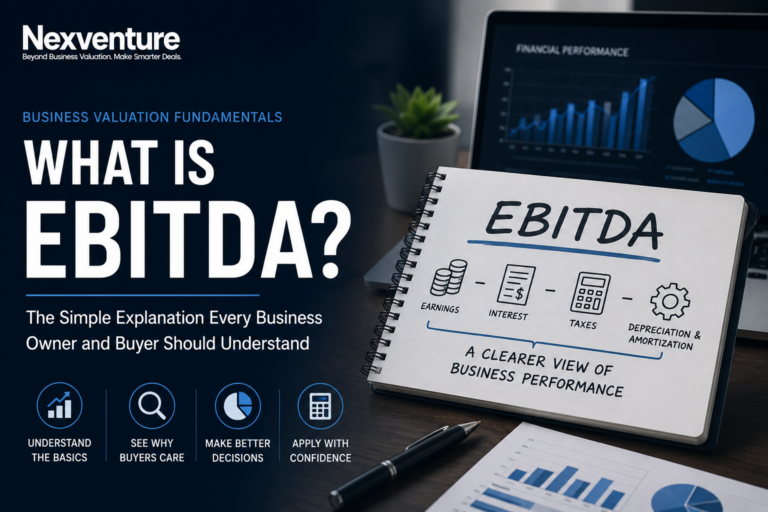
- ⬜ Lesson 2 — What Is EBITDA?
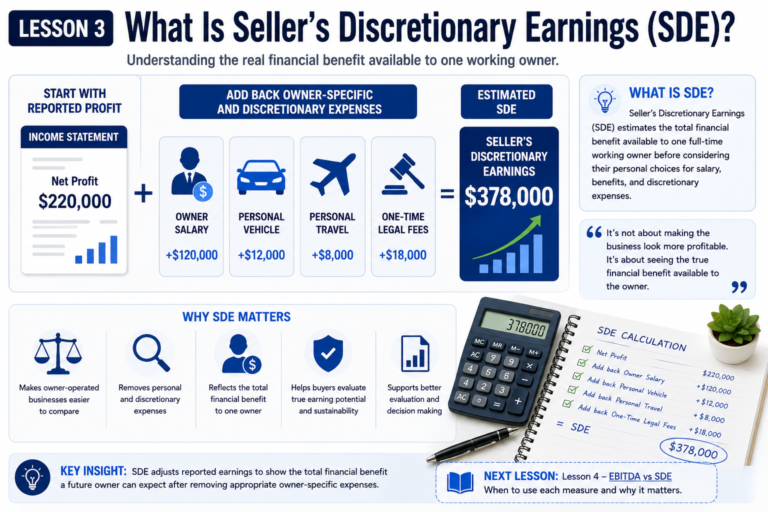
- ⬜ Lesson 3 — What Is Seller’s Discretionary Earnings (SDE)?
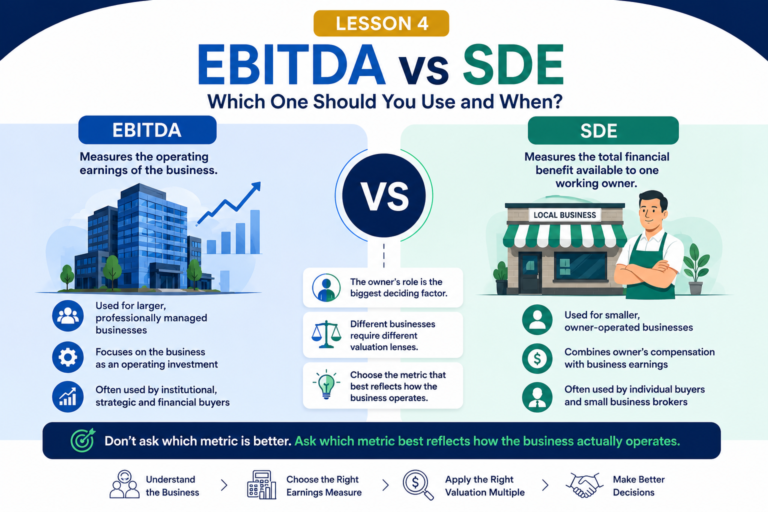
- ⬜ Lesson 4 — EBITDA vs SDE
- ⬜ Lesson 5 — Understanding Valuation Multiples
- ⬜ Lesson 6 — Understanding Add-Backs
- ⬜ Lesson 7 — What Is Goodwill?
- ⬜ Lesson 8 — Understanding Working Capital
🧠 Coming Up Next
Now that you understand what business valuation is trying to achieve, the next lesson introduces EBITDA— one of the most commonly used measures for evaluating a company’s operating profitability.
Bringing It All Together
Business valuation is not about finding one magic formula or one perfect number.
It is about understanding the financial performance, risks, opportunities, and long-term sustainability of a business.
Revenue matters.
Profit matters.
But experienced buyers also evaluate the quality of the business behind those numbers.
As you continue through this learning path, you’ll discover how concepts like EBITDA, SDE, valuation multiples, cash flow, and goodwill each contribute another piece to that larger picture.
If you remember only one thing from this lesson, remember this:
Businesses are not valued only by what they earned yesterday, but by how confidently someone believes they can continue creating value tomorrow.
TLDR: If You Remember Nothing Else, Remember This
- Business valuation is the process of estimating what a business may be worth.
- Revenue and profit are important, but they never tell the complete story.
- Experienced buyers evaluate profitability, risk, and transferability before making an offer.
- Two businesses with similar financial results can have very different values.
- Business valuation is usually an estimated range, not one guaranteed selling price.
- Every financial concept you learn—EBITDA, SDE, cash flow, goodwill, and valuation multiples—helps explain one part of business value.
- Understanding the business behind the numbers is just as important as understanding the numbers themselves.
Common Questions
What is business valuation?
Business valuation is the process of estimating what a business may be worth by considering its financial performance, risks, assets, future potential, and other factors that influence buyer confidence.
Why isn’t revenue enough to value a business?
Revenue shows how much money comes into the business, but it does not show profitability, cash flow, operational efficiency, or the risks that may affect future performance.
Can two businesses with the same profit have different values?
Yes. Customer concentration, management strength, recurring revenue, systems, owner dependency, growth opportunities, and overall risk can all influence value beyond the financial statements.
Why do professional valuations often provide a range?
Because value depends on assumptions, market conditions, negotiation, financing, and buyer expectations. A valuation estimates what a business may be worth—it does not guarantee the final selling price.
Do I need to understand accounting before learning business valuation?
No. This learning path is designed for business owners, buyers, sellers, and entrepreneurs without an accounting background. Each lesson explains financial concepts in practical, everyday language.
What should I learn after this lesson?
The next lesson introduces EBITDA, one of the most widely used financial measures for understanding operating profitability and business valuation.
Start with data. Make decisions with confidence.
Nexventure combines valuation analysis, buyer perspective, risk assessment, and practical business intelligence to help owners, buyers, sellers, and advisors better understand business value and the factors that influence it.
Start Your Free Business Valuation