What Is Seller’s Discretionary Earnings (SDE)? A Simple Guide for Business Owners and Buyers
Seller’s Discretionary Earnings helps reveal the total financial benefit available to one working owner. This lesson explains what SDE means, how it is calculated, which expenses may be added back, and why it is commonly used when valuing owner-operated small businesses.
Lesson 3: Understanding Seller’s Discretionary Earnings
By the end of this lesson, you should understand what Seller’s Discretionary Earnings measures, why it is commonly used for owner-operated businesses, how the calculation works, which expenses may qualify as add-backs, and why buyers carefully review every adjustment.
Imagine you are considering buying a local plumbing company.
The business has a strong reputation, loyal customers, experienced employees, and steady annual revenue. At first glance, it appears to be a promising opportunity.
As you begin reviewing the financial statements, however, you notice something interesting.
The owner pays themselves a salary of $140,000 each year.
The business also pays for the owner’s vehicle, mobile phone, family health insurance, and several travel expenses that may not be necessary for the company’s normal operations.
If you purchased the business, would you continue paying for all of those expenses in exactly the same way?
Probably not.
Some expenses may disappear completely. Others may change depending on how you choose to operate the company.
If you looked only at the profit shown on the income statement, you might underestimate the total financial benefit the business currently provides to its owner.
This is why Seller’s Discretionary Earnings exists.
Seller’s Discretionary Earnings, commonly called SDE, attempts to estimate the total financial benefit available to one full-time working owner of a business.
It begins with the company’s reported earnings and then adjusts for certain expenses that are personal, discretionary, non-recurring, or specific to the current owner.
SDE is commonly used when evaluating smaller, owner-operated businesses where the owner’s compensation and personal financial decisions are closely connected to the company’s reported results.
Throughout this lesson, we will explain what SDE measures, how it is calculated, which expenses may qualify as add-backs, why owner compensation is treated differently, and what buyers examine before accepting an SDE figure.
We will also look at the limitations of SDE, because not every expense labelled as an add-back should automatically be accepted.
Let’s begin with what Seller’s Discretionary Earnings actually means and why it is so widely used in small business valuation.
What Is Seller’s Discretionary Earnings?
Seller’s Discretionary Earnings is an estimate of the total financial benefit available to one full-time owner-operator of a business.
It is designed to show more than the accounting profit reported on the company’s financial statements.
In many small businesses, the owner does not simply receive a salary.
They may also receive benefits through vehicle expenses, insurance, retirement contributions, travel, mobile phones, meals, or other costs paid by the company.
Some of these expenses may be necessary for the business.
Others may reflect the current owner’s personal choices.
SDE attempts to separate those owner-specific decisions from the underlying earning capacity of the business.
Seller’s Discretionary Earnings estimates how much total financial benefit one working owner may receive from the business before considering their individual choices about salary, benefits, and certain discretionary expenses.
This makes SDE especially useful when comparing owner-operated companies that may record owner compensation differently.
One owner may pay themselves a large salary.
Another may take a smaller salary while allowing the company to pay for several personal expenses.
A third may leave most of the earnings inside the business.
Their reported profits may look very different even if the businesses generate a similar economic benefit for their owners.
SDE is not simply the profit shown on the income statement.
It is an adjusted estimate of the total financial benefit available to one full-time working owner.
What does “discretionary” mean?
The word discretionary refers to expenses that depend partly on the owner’s personal choices rather than the unavoidable operating needs of the business.
For example, an owner may choose to lease a more expensive vehicle than the business requires.
They may attend a conference in a destination that combines business travel with a personal vacation.
They may also employ a family member at a salary that is above the normal market rate for the work being performed.
These expenses may be legitimate and properly recorded for accounting or tax purposes.
But a buyer may not expect to continue them after purchasing the business.
That is why they may be reviewed as possible adjustments when calculating SDE.
☕ Coffee Break
SDE does not mean that every expense chosen by the owner should be added back.
It means each expense should be reviewed to determine whether it is necessary, recurring, and likely to continue under new ownership.
Why Does SDE Exist?
After learning about EBITDA in the previous lesson, you may be wondering why another earnings measure is needed.
The answer lies in the way many small businesses are owned and operated.
In a larger company, the owners and the management team are often separate.
Executive salaries, management costs, employee benefits, and operating expenses are generally recorded as normal costs of running the business.
A buyer evaluating that company usually expects to retain a professional management structure after the acquisition.
Owner-operated businesses often work differently.
The owner may act as the chief executive, salesperson, operations manager, customer relationship manager, and problem solver.
They may choose their own salary and decide which benefits or expenses are paid through the company.
As a result, the reported profit may be heavily influenced by the current owner’s personal financial decisions.
SDE helps normalize some of those differences.
It gives buyers a starting point for estimating how much financial benefit the business may provide if they become the next working owner.
🧠 Did You Know?
Two owners can operate similar businesses and report very different profits simply because they pay themselves differently or run different personal benefits through their companies.
SDE helps make owner-operated businesses easier to compare
Imagine two similar cleaning companies.
Each generates $1 million in annual revenue before considering the owner’s individual compensation choices.
The owner of Business A pays themselves a salary of $180,000.
The owner of Business B pays themselves $80,000 but receives additional benefits through the company, including a vehicle, insurance, travel, and retirement contributions.
Business B may appear more profitable on paper because it records a lower owner salary.
But that does not automatically mean it provides a greater total benefit to its owner.
SDE attempts to adjust for those differences so the businesses can be reviewed on a more comparable basis.
This does not make SDE a perfect measure.
It simply makes it a useful starting point when evaluating smaller businesses where one owner is actively involved in daily operations.
How Is Seller’s Discretionary Earnings Calculated?
One of the reasons SDE is widely used is because the overall idea is relatively straightforward.
Rather than looking only at the profit reported on the financial statements, SDE adjusts those earnings to better reflect the total financial benefit available to a single working owner.
While every business is different, the process usually follows the same general approach.
| Step | Purpose |
|---|---|
| Start with reported earnings | Use the company’s financial statements as the starting point. |
| Add back owner compensation | Reflect the financial benefit available to a new owner. |
| Add back discretionary expenses | Remove expenses that may not continue after the sale. |
| Add back one-time expenses | Exclude unusual costs that are unlikely to happen again. |
| Review every adjustment | Confirm each add-back is reasonable and supported. |
Although this process sounds simple, determining whether an expense truly qualifies as an add-back often requires careful judgment.
Calculating SDE is not about adding back as many expenses as possible.
It is about making adjustments that fairly represent how the business may perform under new ownership.
Where Does the Calculation Begin?
Most SDE calculations begin with the business’s reported net profit.
This figure comes directly from the company’s income statement after normal operating expenses have already been deducted.
From there, adjustments are made to remove items that may not reflect the business’s ongoing earning potential.
These adjustments are commonly known as add-backs.
An add-back is simply an expense that a buyer believes may not continue after purchasing the business.
The goal is not to make the business appear more profitable than it really is.
The goal is to estimate the financial benefit available to the next owner if those owner-specific expenses no longer exist.
☕ Coffee Break
Think of the income statement as the starting point—not the final answer.
SDE asks, “Which of these expenses truly belong to the business, and which belong mainly to the current owner?”
Common SDE Add-Backs
Every business is unique, so there is no universal list of add-backs.
However, several categories appear frequently in owner-operated businesses.
| Possible Add-Back | Why It May Be Adjusted |
|---|---|
| Owner salary | The next owner may choose different compensation. |
| Personal vehicle expenses | May not be required after the sale. |
| Personal travel | Some travel may be discretionary rather than operational. |
| Personal mobile phone | May represent an owner benefit instead of a business need. |
| One-time legal or consulting fees | May not occur again in future years. |
| Non-recurring repairs or losses | Do not necessarily reflect ongoing operations. |
Not every expense in these categories automatically qualifies as an add-back.
Buyers typically request supporting documentation before accepting any adjustment.
Why Is Owner Salary Usually Added Back?
For many people, this is the most confusing part of SDE.
If the owner is paid a salary, why would that salary be added back?
The answer is that SDE assumes one full-time owner will continue operating the business after the purchase.
Since different owners choose to compensate themselves differently, salary alone does not provide a fair basis for comparing businesses.
One owner may pay themselves $200,000.
Another may pay themselves only $60,000 while leaving more profit inside the company.
Those choices affect the reported earnings but may not change the overall financial benefit produced by the business.
By adding back the owner’s compensation, SDE attempts to place businesses on a more comparable basis.
SDE assumes one owner is actively working in the business.
It is measuring the total benefit available to that owner—not separating wages from investment returns.
What About Personal and Discretionary Expenses?
Many owner-operated businesses include expenses that partly benefit the owner personally.
These expenses may be completely legitimate for accounting or tax purposes.
The important question for valuation is different.
Would a reasonable new owner continue paying this expense after purchasing the business?
If the answer is no, that expense may qualify as an add-back.
Examples might include personal vehicle costs, family mobile phone plans, discretionary travel, club memberships, or other benefits that are closely tied to the current owner’s lifestyle.
Every adjustment should be supported by evidence and evaluated individually.
🧠 Did You Know?
Buyers often challenge discretionary expenses during due diligence because every accepted add-back can increase the estimated value of the business.
One-Time and Unusual Expenses
Not every expense recorded on the income statement represents the normal operation of the business.
Sometimes a company incurs costs that are unusual, unexpected, or unlikely to happen again.
If those expenses genuinely will not continue after the sale, buyers may consider adding them back when estimating Seller’s Discretionary Earnings.
Examples might include legal fees related to a one-time lawsuit, emergency repairs following a natural disaster, relocation costs, or consulting fees for a special project that has already been completed.
These adjustments help buyers understand what the business may earn during a more typical year rather than judging it based on an exceptional event.
A Practical SDE Example
Let’s see how Seller’s Discretionary Earnings works in practice.
Imagine a small marketing agency reports the following results for the year.
| Item | Amount |
|---|---|
| Reported Net Profit | $220,000 |
| Add back: Owner’s Salary | +$120,000 |
| Add back: Personal Vehicle | +$12,000 |
| Add back: One-Time Legal Expense | +$18,000 |
| Estimated Seller’s Discretionary Earnings | $370,000 |
Notice that the business did not suddenly become more profitable.
The calculation simply estimates the total financial benefit that may be available to one owner after adjusting for expenses that are specific to the current owner’s circumstances.
Another buyer may review the same business and disagree with one or more of these adjustments.
That is perfectly normal.
SDE is based on reasonable assumptions supported by evidence, not automatic rules.
☕ Coffee Break
Think of SDE like cleaning a window.
The business itself hasn’t changed—you’ve simply removed some of the owner’s personal decisions so buyers can see the underlying earning potential more clearly.
Is SDE the Same as Cash Flow?
Not exactly.
Although the two concepts are related, they answer different questions.
Cash flow measures how money moves into and out of a business over time.
Seller’s Discretionary Earnings estimates the total financial benefit available to one working owner after making appropriate adjustments.
A business can have healthy SDE while still experiencing periods of tight cash flow because customers pay slowly or inventory requires significant investment.
Likewise, strong cash flow does not automatically mean SDE is high.
Each measure provides different information about the business.
Cash flow explains how money moves through the business.
SDE estimates the total economic benefit available to one owner.
The Limitations of Seller’s Discretionary Earnings
Like every financial measure, SDE has limitations.
It is a useful tool, but it should never be viewed as the only number that determines business value.
Buyers still evaluate customer concentration, recurring revenue, competition, management strength, equipment condition, industry outlook, and many other factors before deciding what a business is worth.
They also review every proposed add-back carefully.
If an adjustment cannot be supported with evidence or appears to benefit only the seller, buyers may reject it completely.
This is one reason professionally prepared financial records and clear documentation often increase buyer confidence during due diligence.
🧠 Did You Know?
Two advisors reviewing the same business may calculate slightly different SDE figures depending on which adjustments they believe are reasonable. That is why valuation often involves professional judgment as well as financial analysis.
Looking at SDE Through a Buyer’s Eyes
Imagine you’re about to invest hundreds of thousands—or even millions—of dollars into a business.
Would you simply accept every add-back listed by the seller?
Probably not.
You would want evidence.
You would ask whether each adjustment is reasonable, whether it is likely to continue after the purchase, and whether it truly reflects the ongoing earning potential of the business.
This is exactly how experienced buyers approach Seller’s Discretionary Earnings.
SDE is not about making a business look more profitable.
It is about presenting a fair picture of the financial benefit a future owner may reasonably expect.
The stronger the evidence supporting each adjustment, the more confidence buyers are likely to have in the final SDE calculation.
A Practical Reflection
Seller’s Discretionary Earnings is often introduced as a financial calculation.
In reality, it is really about understanding how a business supports its owner.
Every owner makes different financial decisions.
Some take a large salary.
Others leave more money inside the company.
Some choose to run certain personal expenses through the business.
Those decisions can make similar businesses appear very different on paper.
Seller’s Discretionary Earnings helps remove some of those differences so buyers can better understand the earning potential of the business itself.
That does not mean every adjustment should automatically be accepted.
Every add-back should be reasonable, supported by evidence, and capable of withstanding buyer scrutiny during due diligence.
A strong SDE calculation is not built on creative accounting.
It is built on transparent financial records and adjustments that fairly represent the business under new ownership.
Understanding that difference will help you become both a better buyer and a better seller.
🗣 Business Translation
If someone says:
“This business generates approximately $450,000 in Seller’s Discretionary Earnings.”
What they are really saying is:
“After adjusting for owner-specific compensation, discretionary expenses, and certain one-time costs, we estimate that one full-time owner could reasonably receive about $450,000 in total annual financial benefit.”
It does not mean every buyer will agree with every adjustment.
It is simply an estimate based on the available financial information and the assumptions used during the valuation process.
🎯 Before You Move On
If you can answer these questions, you’ve understood the core ideas from this lesson.
1. What does Seller’s Discretionary Earnings (SDE) measure?
2. Why is SDE commonly used for owner-operated businesses instead of relying only on reported profit?
3. What is an add-back, and why are buyers careful when reviewing them?
4. Why is owner salary usually added back when calculating SDE?
5. Why shouldn’t every personal or unusual expense automatically be treated as an add-back?
📚 Continue Learning
Every lesson builds on the previous one. Continue expanding your understanding of business valuation one concept at a time.
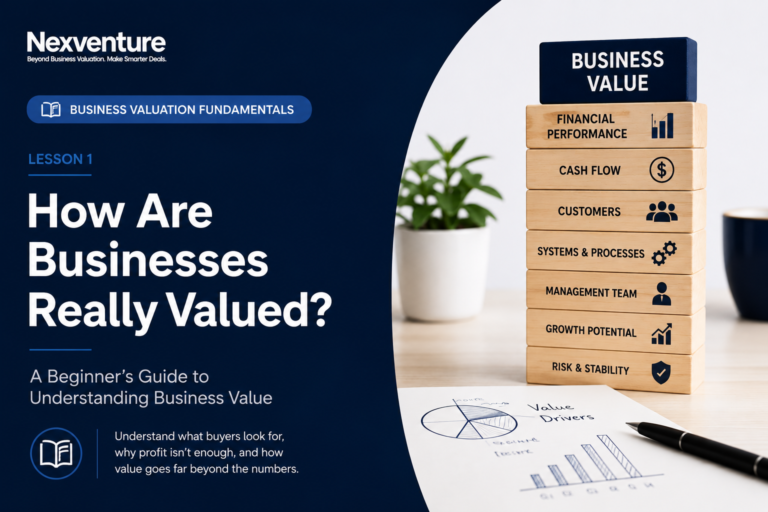
- ✅ Lesson 1 — How Businesses Are Really Valued
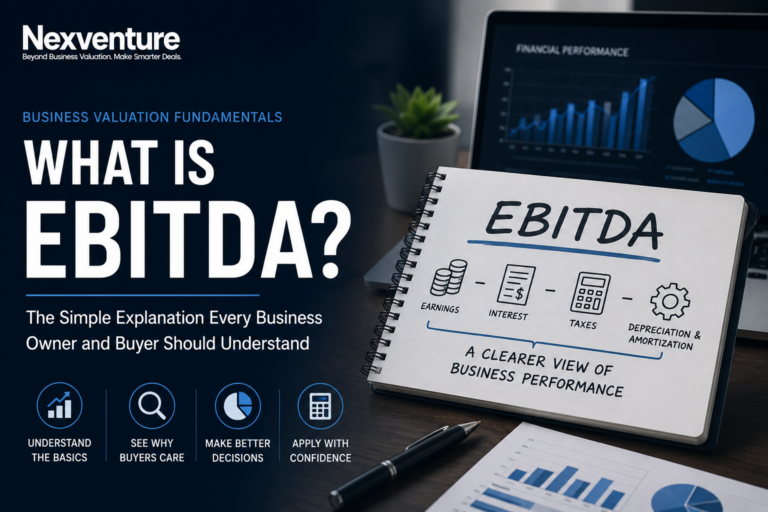
- ✅ Lesson 2 — What Is EBITDA?
- ⬜ Lesson 3 — What Is Seller’s Discretionary Earnings (Current Lesson)
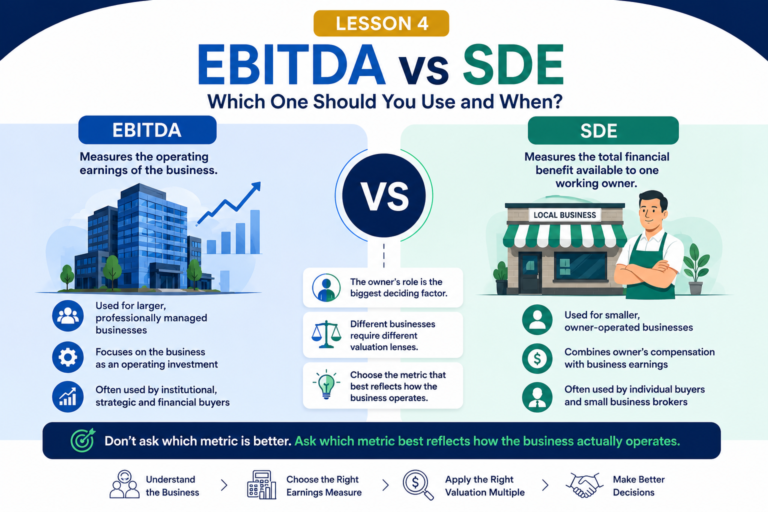
- ⬜ Lesson 4 — EBITDA vs SDE
- ⬜ Lesson 5 — Understanding Valuation Multiples
- ⬜ Lesson 6 — Understanding Add-Backs
- ⬜ Lesson 7 — What Is Goodwill?
- ⬜ Lesson 8 — Understanding Working Capital
🧠 Coming Up Next
Now that you understand how Seller’s Discretionary Earnings works, the next lesson compares SDE and EBITDA—explaining when each measure is used, how they differ, and why choosing the right one matters when valuing a business.
Bringing It All Together
Seller’s Discretionary Earnings helps buyers look beyond the accounting profit reported on a company’s financial statements.
By adjusting for owner compensation, discretionary expenses, and certain non-recurring costs, SDE provides a clearer picture of the financial benefit that may be available to a future owner.
It is one of the most commonly used earnings measures for owner-operated small businesses because it recognizes that every owner structures compensation differently.
At the same time, SDE is only one part of the valuation process.
Buyers still evaluate risk, recurring revenue, customer concentration, management strength, systems, and many other factors before deciding what a business may be worth.
If you remember only one thing from this lesson, remember this:
Seller’s Discretionary Earnings is not about making a business look more profitable.
It is about fairly estimating the total financial benefit available to one working owner.
TLDR: If You Remember Nothing Else, Remember This
- Seller’s Discretionary Earnings (SDE) estimates the total financial benefit available to one working owner.
- SDE is commonly used when valuing owner-operated small businesses.
- It starts with reported earnings and adjusts for appropriate add-backs.
- Common add-backs include owner compensation, discretionary expenses, and certain one-time costs.
- Every add-back should be reasonable, well documented, and supported by evidence.
- SDE is one important valuation measure, but buyers also evaluate risk, transferability, and future earning potential.
- The next lesson explains when to use SDE versus EBITDA.
Common Questions
What is Seller’s Discretionary Earnings (SDE)?
Seller’s Discretionary Earnings estimates the total financial benefit available to one working owner after adjusting for owner compensation and certain discretionary or non-recurring expenses.
Who uses SDE?
SDE is commonly used by business buyers, sellers, brokers, advisors, and valuation professionals when evaluating owner-operated small businesses.
Why is owner salary added back?
Different owners compensate themselves differently. Adding back owner compensation helps buyers compare businesses on a more consistent basis when one owner is expected to operate the business after purchase.
Does every personal expense qualify as an add-back?
No. Every adjustment should be reviewed individually and supported by evidence. Buyers often reject add-backs that are not reasonable or are likely to continue after the sale.
Is SDE better than EBITDA?
Neither measure is universally better. SDE is generally more appropriate for owner-operated businesses, while EBITDA is more commonly used for larger companies. The next lesson explores those differences in detail.
What should I learn after this lesson?
Continue with Lesson 4 to understand the differences between EBITDA and SDE, when each measure is used, and why choosing the correct metric matters during business valuation.
See beyond the numbers with Nexventure.
Nexventure combines valuation analysis, buyer perspective, risk assessment, and practical business intelligence to help owners, buyers, sellers, and advisors better understand business value and the factors that influence it.
Start Your Free Business Valuation