7 Costly Mistakes First-Time Business Buyers Make
Buying a business can be one of the smartest moves you make, but only if you understand the numbers, risks, systems, and seller story before making an offer.

A lot of first-time business buyers start with a simple thought.
“Instead of starting something from zero, maybe I should buy an existing business.”
And honestly, that thought makes sense. An existing business may already have customers, revenue, staff, systems, suppliers, a location, a phone number people recognize, and maybe even a decent reputation in the market.
On paper, it can feel safer than starting from scratch.
But this is where buyers need to slow down a little.
Buying a small business is not just about finding something profitable. It is about understanding what kind of profit it is, how stable it is, how dependent it is on the current owner, and whether the business can realistically transfer to you without falling apart.
I’ve seen this happen more often than people realize. A buyer looks at a business, gets excited by the revenue, likes the location, likes the seller, maybe even imagines themselves running it. Then later, during due diligence, they realize the business is not as simple as it looked.
The numbers may be messy. The owner may be doing everything. One customer may be responsible for a large portion of sales. Staff may not be as stable as expected. Or the asking price may be based more on the seller’s emotional expectation than actual valuation logic.
None of this means the business is bad.
It just means the buyer has to think like an owner before becoming one.
Here’s a practical way to think through the mistakes that can quietly turn a promising business acquisition into an expensive lesson.
1. Falling in love with the business before understanding the numbers
This is probably the most human mistake on the list.
A buyer sees a business that feels right. Maybe it is a café in a good neighborhood, a service business with steady calls, a small manufacturing company with long-time customers, or an online business that looks simple to operate.
The buyer starts imagining the future. New branding. Better marketing. More efficiency. Maybe expansion.
That imagination is not wrong. In fact, buyers need vision.
But vision without numbers can become dangerous very quickly.
Before getting emotionally attached, a buyer needs to understand the basics clearly:
- How much real profit does the business produce?
- How consistent has that profit been?
- Are the financials clean and supported?
- What is the owner paying themselves?
- Are there add-backs being used to inflate SDE?
- What expenses might return after the sale?
- Is the asking price reasonable compared to the actual risk?
First-time buyers sometimes look at revenue and assume a business is strong. But revenue only tells you how much money came in. It does not tell you how much stayed, how hard it was to earn, or how risky that income is after ownership changes.
A good business acquisition starts with curiosity, not excitement.
Excitement can come later. First, the numbers need to make sense.
From the seller’s side, these risks also explain why some businesses generate stronger buyer interest while others sit on the market longer than expected. Buyers are not only evaluating profit. They are evaluating confidence, transferability, and risk. This related article explains it from the seller perspective: Why Some Businesses Sell Quickly While Others Sit on the Market for Months .
2. Focusing on revenue instead of cash flow and profit
Revenue is easy to understand.
Profit is where the real story starts.
A business doing $1 million in annual revenue may look impressive, but if it only produces $60,000 in true owner benefit, the buyer has to be careful. After debt payments, working capital needs, repairs, payroll pressure, and unexpected expenses, that business may not support the buyer the way they expect.
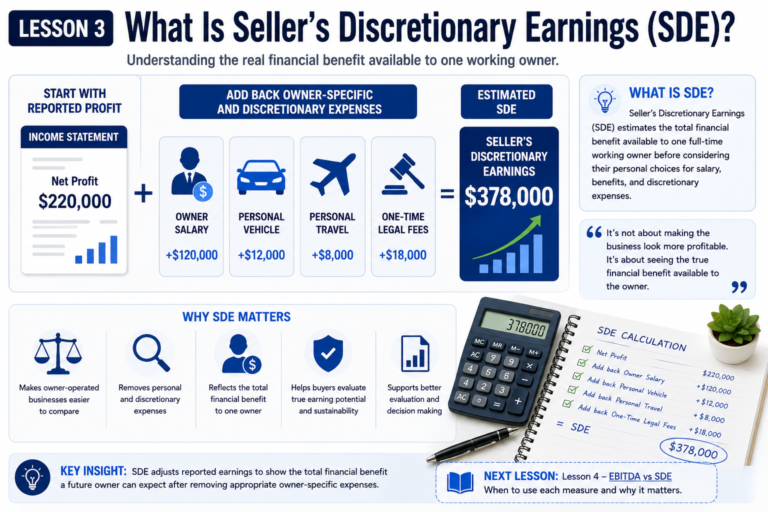
This is why small business valuation often focuses on SDE, which means Seller’s Discretionary Earnings, or EBITDA for larger and more mature businesses. These numbers help estimate what the business actually produces for an owner, not just what flows through the bank account.
In my experience, this is where many first-time buyers get surprised. They see strong sales but later realize the margin is thin, the payroll is heavy, rent is increasing, equipment is aging, or the seller has been working long hours to keep the profit alive.
That last part matters.
A business that produces $200,000 in SDE while the owner works 60 hours a week is different from a business that produces $200,000 with a trained manager, repeatable systems, and clean reporting.
Same profit number.
Very different business.
A buyer should also look at profit trends, not just one year of results. One strong year can happen for many reasons. Maybe demand temporarily increased. Maybe expenses were delayed. Maybe the seller reduced staff. Maybe the owner stopped investing in marketing to make the financials look better before selling.
This is why acquisition due diligence should never stop at top-line revenue.
Cash flow is what gives the buyer breathing room.
3. Skipping independent valuation logic
A seller can ask whatever they want.
That does not mean the business is worth that amount.
This sounds obvious, but in real transactions, buyers often get anchored by the asking price. If the seller lists the business at $650,000, the buyer starts negotiating around that number. Maybe they offer $575,000. Maybe $600,000. But the real question should come before negotiation:
Why is this business worth anywhere near that amount?
Business valuation is not just a formula. A business valuation calculator or business valuation software can help create a starting point, but the logic behind the number matters more than the number itself.
A buyer should understand:
- What earnings figure is being used?
- What valuation multiple is being applied?
- Is the multiple reasonable for this industry and risk profile?
- Are the financials reliable?
- Is goodwill transferable?
- Would a lender support this valuation?
- What risks should reduce buyer confidence?
A small business valuation is not only about what the seller earned. It is also about how likely the buyer is to continue earning it after closing.
That is where many deals become less clear.
For example, a business may show good earnings, but if those earnings depend heavily on the seller’s personal relationships, special technical knowledge, or daily involvement, the valuation multiple should usually reflect that risk.
If you want a deeper buyer-side view of what makes a business attractive or risky, this related Nexventure article may help: What Buyers Look for Before Buying a Small Business.
A buyer does not need to become a certified appraiser to think clearly. But they do need a valuation framework.
That framework protects them from overpaying.
4. Ignoring owner dependency
Owner dependency is one of the biggest hidden risks in small business acquisitions.
And it is easy to miss at first.
Many small businesses are built around the owner. The owner sells, hires, trains, handles complaints, approves pricing, manages suppliers, fixes mistakes, remembers customer preferences, and somehow keeps the whole thing moving.
From the outside, it looks like a business.
But sometimes, it is really the owner plus a few supporting parts.
That does not mean it is a bad business. Many great businesses start that way. But for a buyer, owner dependency affects valuation, transition risk, financing confidence, and post-closing stress.
What buyers should ask:
- What does the owner personally do every week?
- Which customer relationships depend on the owner?
- Can staff run the business without constant owner involvement?
- Are processes documented?
- Would revenue drop if the owner left too quickly?
- How long should the seller stay during transition?
I’ve seen businesses that looked strong financially but became much less attractive once the buyer realized the owner was the system.
That phrase sounds simple, but it matters.
If the owner is the system, the buyer is not just buying cash flow. They are buying a job, a learning curve, and a transition risk.
A business with lower profit but stronger systems may sometimes be safer than a higher-profit business that depends entirely on one person.
Buyers should pay attention to that.
5. Overlooking customer concentration risk
Customer concentration sounds technical, but the idea is simple.
If too much revenue comes from too few customers, the business may be riskier than it looks.
Imagine a business with $900,000 in annual revenue. It looks stable. The seller says customers are loyal. The financials show profit.
But then during due diligence, the buyer finds out that one customer represents 38 percent of revenue.
Now the story changes.
If that customer leaves after the sale, renegotiates pricing, delays payment, or simply does not connect with the new owner, the buyer may be in trouble.
This is especially important in service businesses, B2B companies, distribution businesses, manufacturing, agencies, and professional service firms. But honestly, it can show up almost anywhere.
Buyers should review:
- Top 5 and top 10 customers by revenue
- How long those customers have been active
- Whether contracts exist
- Whether revenue is recurring or project-based
- Whether customers are connected to the owner personally
- Whether pricing is sustainable
One thing most people underestimate is how emotional customer relationships can be in small businesses. Customers may say they are loyal to the company, but in reality, they may be loyal to the owner, a manager, a technician, or even a specific way of being treated.
Buyer confidence increases when revenue is spread across many customers, supported by repeat demand, and not overly dependent on one relationship.
That kind of revenue usually deserves more trust.
6. Underestimating weak systems and messy operations
Some businesses make money despite being messy.
That can confuse buyers.
The profit looks fine, so the buyer assumes the business is healthy. But operationally, things may be held together by memory, habits, and constant owner involvement.
No clean CRM. No documented process. No reliable reporting. No clear job costing. No proper customer follow-up. No training manual. No inventory controls. No consistent marketing system.
Again, this does not automatically mean the business is bad.
It may even mean there is upside.
But the buyer has to know the difference between “easy improvement opportunity” and “hidden operational chaos.”
Messy operations can create real post-closing problems:
- Staff confusion after transition
- Customer service issues
- Missed invoices or poor collections
- Inventory shrinkage
- Inaccurate margins
- Owner burnout
- Unexpected working capital pressure
A lot of first-time buyers say, “I can fix this after I buy it.”
Sometimes they can.
But they should price that effort into the deal.
A business that needs major cleanup should not be valued the same as a business with clean systems, reliable staff, organized financials, and transferable processes.
For sellers, this is also why preparation matters before going to market. Organized businesses usually create more buyer confidence. If you are looking at the seller side of valuation, this article may also be useful: How Much Is My Small Business Worth in Canada?
7. Paying attention to the asking price instead of the deal structure
Price matters.
But deal structure can matter just as much.
First-time buyers often focus heavily on the purchase price. They want to know if the business is worth $400,000, $700,000, or $1.2 million.
Fair question.
But a business acquisition is not only about what you pay. It is also about how you pay, when you pay, what protection you have, and how much risk stays with the seller.
A lower price with poor structure can still be risky. A higher price with smart structure may sometimes be more manageable.
Buyers should think about:
- Seller financing
- Earnouts
- Transition support
- Working capital requirements
- Asset purchase versus share purchase
- Holdbacks
- Training period
- Non-compete or non-solicitation terms
- Financing conditions
For example, if a business depends heavily on the seller’s relationships, the buyer may want a longer transition period or part of the payment tied to customer retention.
If financials are not clean, the buyer may need stronger conditions, a lower price, or more seller participation.
If the business has strong recurring revenue, clean systems, and low owner dependency, the buyer may feel more comfortable with less protective structure.
Better acquisitions usually come from better visibility.
The more clearly a buyer understands risk, the more intelligently they can negotiate.
A practical reflection: the business is not the only thing being evaluated
Many first-time buyers think they are only evaluating the business.
But in reality, they are also evaluating themselves.
Can I run this business?
Can I manage the staff?
Can I keep the customers?
Can I handle the first year if things are harder than expected?
Can I replace what the seller does every day?
These are not small questions.
A business can be good and still not be the right acquisition for a specific buyer. I’ve seen buyers walk away from decent businesses because they realized the transition risk was too high for their experience level. That is not failure. That is good judgment.
I’ve also seen buyers take average-looking businesses and do well because they understood the risk clearly before closing. They knew what needed fixing. They negotiated accordingly. They did not pretend the business was perfect.
That kind of honesty matters.
Buying a business is not about finding a flawless opportunity. Most small businesses have issues. The real question is whether the issues are visible, manageable, and priced into the deal.
Related Nexventure insights
If you are evaluating a business or trying to understand valuation from a buyer’s perspective, these Nexventure resources may help:
Bringing it all together
Buying a small business can be a very smart path.
But it is not something to do casually.
The first-time buyers who usually make better decisions are not necessarily the most aggressive buyers. They are the ones who slow down enough to understand the business underneath the listing.
They look past revenue.
They question the valuation.
They study the owner’s role.
They check customer concentration.
They look at systems, staff, cash flow, and deal structure.
Most importantly, they do not confuse a good story with a good acquisition.
A strong business acquisition is not built on hope. It is built on visibility.
TLDR: If you remember nothing else, remember this:
- Do not fall in love with the business before understanding the numbers.
- Revenue is not the same as real owner cash flow.
- The seller’s asking price is not the same as valuation.
- Owner dependency can make a profitable business much riskier.
- Customer concentration can quietly reduce buyer confidence.
- Messy operations may create post-closing stress and hidden costs.
- Deal structure can protect you just as much as price negotiation.
- Better acquisitions usually come from better visibility before closing.
FAQ
What is the biggest mistake first-time business buyers make?
The biggest mistake is usually getting emotionally attached before understanding the financials, risks, and transferability of the business. Excitement is natural, but it should not replace proper due diligence.
How do I know if a small business is overpriced?
Start by reviewing the real cash flow, valuation multiple, industry risk, owner dependency, customer concentration, and quality of financial records. A business can be profitable and still overpriced if the risk is too high.
Should I use a business valuation tool before making an offer?
Yes, a business valuation tool can give you a clearer starting point. It should not replace professional advice, but it can help you understand whether the asking price feels reasonable before you go deeper.
What financial number should buyers focus on?
Buyers usually need to look beyond revenue and focus on SDE, EBITDA, cash flow, margins, working capital needs, and debt service ability. The real question is how much cash the business can reliably produce after closing.
Why does owner dependency affect valuation?
If the business depends heavily on the current owner, the buyer faces more transition risk. That can reduce buyer confidence and may justify a lower valuation multiple or stronger deal protections.
Is buying a business safer than starting one?
Sometimes, but not always. Buying a business may reduce startup risk, but it can introduce acquisition risk. Hidden financial issues, weak systems, customer concentration, or poor transition planning can still create problems.
Get a clearer valuation starting point with Nexventure.
Nexventure helps buyers understand valuation range, buyer confidence, risk signals, and acquisition concerns before moving deeper into a deal.
Start Free Valuation