Understanding Working Capital in a Business Sale: What Buyers and Sellers Need to Know
Learn what working capital means, how it is calculated, why businesses need it, and why buyers and sellers often pay close attention to working capital when negotiating a business transaction.
Lesson 8: Understanding Working Capital
In this lesson, you’ll learn what working capital is, why an operating business needs it, and how working capital can become an important part of the negotiation when a business changes hands.
Introduction
A profitable business can still run into trouble if it doesn’t have enough resources available to support its day-to-day operations.
Employees need to be paid.
Suppliers send invoices.
Customers may take 30, 45, or 60 days to pay.
Inventory may need to be purchased before it can be sold.
All of this creates a timing gap between money coming into the business and money going out.
Working capital helps a business operate through that gap.
And when a business is sold, working capital becomes especially important.
A buyer generally wants to acquire an operating business with enough working capital to continue normal operations after closing.
A seller, meanwhile, wants to understand exactly what is expected to remain in the business—and whether the final purchase price could change if the amount delivered at closing is different from what was agreed.
Key Insight
Working capital isn’t simply an accounting number. In a business sale, it can become an important negotiation about what the buyer needs to receive for the business to continue operating normally after closing.
What Is Working Capital?
At its simplest, working capital measures the difference between a company’s current assets and current liabilities.
Working Capital Formula
Working Capital = Current Assets − Current Liabilities
Current assets are generally assets expected to be converted into cash, sold, or used within the normal operating cycle or within approximately one year.
Current liabilities are generally obligations expected to be paid within the normal operating cycle or within approximately one year.
But when we’re discussing the sale of a business, there is an important complication.
The transaction definition of working capital may not include every current asset and current liability appearing on the balance sheet.
The parties may agree to exclude items such as cash, debt, income taxes, or other non-operating balances.
We’ll explore that distinction later in this lesson.
Current Assets and Current Liabilities
Before looking at business-sale negotiations, it helps to understand the basic components.
Common Current Assets
Depending on the business, current assets may include:
- Cash and cash equivalents
- Accounts receivable
- Inventory
- Prepaid expenses
- Other short-term operating assets
Common Current Liabilities
Current liabilities may include:
- Accounts payable
- Accrued expenses
- Short-term obligations
- Current portions of certain debts
- Other short-term operating liabilities
Business Translation
Think of working capital as some of the short-term resources and obligations moving through the business while it operates.
Customers owe the company money, inventory is waiting to be sold, suppliers need to be paid, and expenses continue arriving while the business waits for cash to come in.
Important Distinction
Don’t assume every item classified as “current” on the balance sheet will automatically be included in working capital for a business sale. The transaction documents should define exactly which accounts are included and excluded.
The Working Capital Formula
Let’s start with a simple accounting example.
| Current Assets | Amount |
|---|---|
| Cash | $50,000 |
| Accounts Receivable | $180,000 |
| Inventory | $120,000 |
| Total Current Assets | $350,000 |
| Current Liabilities | Amount |
|---|---|
| Accounts Payable | $100,000 |
| Accrued Expenses | $40,000 |
| Total Current Liabilities | $140,000 |
Using the basic formula:
$350,000 − $140,000 = $210,000 of working capital
That is the straightforward accounting calculation.
However, suppose the business is being sold on a cash-free, debt-free basis and the transaction definition excludes cash.
The working capital calculation used for the transaction could therefore be different from the $210,000 accounting figure.
This is why buyers and sellers need to understand the agreed definition rather than relying only on the working capital number shown in the financial statements.
Why Businesses Need Working Capital
Businesses rarely receive money from customers at exactly the same moment they need to pay every operating expense.
Consider a company that purchases inventory today, sells it next week, and then gives its customer 30 days to pay.
The company may need to pay its supplier before it receives the customer’s money.
During that period, it still has payroll, rent, utilities, and other expenses.
Working capital helps support that operating cycle.
☕ Think About the Timing
A business can show a profit on its income statement and still experience cash pressure.
If customers haven’t paid yet but employees and suppliers need to be paid now, the business still needs enough liquidity to keep operating.
Profitability and short-term liquidity are related, but they are not the same thing.
Different businesses can also have very different working capital needs.
A consulting company that invoices customers quickly and carries no inventory may require relatively little operating working capital.
A distributor carrying significant inventory and offering customers long payment terms may require much more.
That’s why there isn’t one universal amount of working capital that every business should have.
Positive vs Negative Working Capital
When current assets exceed current liabilities, a business has positive working capital.
When current liabilities exceed current assets, it has negative working capital.
At first glance, positive working capital may sound good and negative working capital may sound bad.
But the reality is more nuanced.
Positive Working Capital
Positive working capital generally means the business has more current assets than current liabilities under the calculation being used.
This may provide a short-term financial cushion, but a very high working capital balance is not automatically a sign of an efficient business.
For example, unusually high accounts receivable could mean customers are taking too long to pay, while excessive inventory could mean cash is tied up in products that are moving slowly.
Negative Working Capital
Negative working capital means current liabilities exceed current assets under the calculation being used.
In some businesses, this may indicate liquidity pressure.
But in certain business models, negative operating working capital can be completely normal.
For example, some businesses collect cash from customers quickly but pay suppliers later. That timing can allow the business to operate with relatively little—or even negative—net working capital.
Key Insight
Working capital should be evaluated in the context of the business model, industry, operating cycle, and historical performance. Positive isn’t automatically healthy, and negative isn’t automatically unhealthy.
Working Capital in a Business Sale
Working capital becomes especially important when ownership changes.
Imagine buying a business on Friday and taking control on Monday.
Customers may still owe the business money.
Suppliers may still need to be paid.
Inventory may need to remain available for customers.
Payroll and other operating expenses don’t stop simply because ownership changed.
A buyer therefore wants to understand whether the business will be delivered with the level of operating working capital contemplated by the transaction.
This is one reason many business-sale agreements establish an agreed level of working capital to be delivered at closing.
Business Translation
A buyer generally doesn’t want to pay for a normally operating business and then immediately discover that they need to inject additional cash because receivables, inventory, or other operating resources were removed before closing.
What Is Normalized Working Capital?
The amount of working capital on one particular day may not represent what the business normally needs.
Balances can change because of seasonality, unusual customer payments, inventory purchases, supplier timing, rapid growth, or temporary changes in operations.
That’s why buyers and sellers may look at normalized working capital.
In simple terms, normalized working capital is an estimate of the level of operating working capital reasonably required to support the business under normal conditions.
Historical monthly balances are often reviewed to understand what “normal” looks like.
Depending on the business, the analysis may consider:
- Historical accounts receivable
- Inventory levels
- Accounts payable
- Accrued operating expenses
- Seasonality
- Revenue growth or decline
- Changes in payment terms
- Unusual or non-recurring balances
Important
Normalized working capital isn’t necessarily the balance from the most recent month, and it isn’t always a simple twelve-month average. The appropriate methodology depends on the business and the terms negotiated between the parties.
Understanding the Working Capital Target
In many transactions, the buyer and seller agree on a specific amount of working capital that is expected to be delivered with the business.
This amount is often called the working capital target or working capital peg.
Suppose the parties agree that the business should be delivered with $250,000 of defined working capital.
That $250,000 becomes the target against which the actual closing working capital can be compared.
| Working Capital | Amount |
|---|---|
| Agreed Working Capital Target | $250,000 |
| Actual Working Capital at Closing | $220,000 |
| Shortfall | $30,000 |
In a transaction with a dollar-for-dollar working capital adjustment, that $30,000 shortfall could reduce the amount ultimately paid to the seller by $30,000.
Now suppose actual working capital were $275,000 instead.
That would be $25,000 above the target, which could result in a $25,000 upward adjustment if the purchase agreement provides for that treatment.
☕ Why This Matters
A seller can negotiate a headline business value and still receive a different final amount because of adjustments made at closing.
Working capital is one of the mechanisms that can create that difference.
How Working Capital Can Affect Purchase Price
One of the biggest misunderstandings in business sales is assuming that the negotiated headline value is automatically the amount the seller will receive.
A transaction may start with an agreed enterprise value, but the final equity value or closing proceeds can be affected by several adjustments depending on the deal structure.
These may include:
- Cash
- Debt
- Working capital adjustments
- Transaction expenses
- Other specifically negotiated items
A simplified transaction bridge might look like this:
| Item | Amount |
|---|---|
| Enterprise Value | $2,000,000 |
| Plus: Cash Retained/Transferred Under Deal Terms | +$50,000 |
| Less: Debt | -$150,000 |
| Less: Working Capital Shortfall | -$30,000 |
| Illustrative Equity Value | $1,870,000 |
This is only a simplified illustration.
Real transactions can define cash, debt, debt-like items, working capital, transaction expenses, and other adjustments differently.
Key Insight
The headline valuation and the seller’s final proceeds are not necessarily the same number. Understanding the transaction bridge is just as important as understanding the valuation itself.
What Does Cash-Free, Debt-Free Mean?
Many private-company transactions are discussed on a cash-free, debt-free basis.
In simplified terms, this generally means the agreed enterprise value assumes the seller retains or receives credit for cash according to the deal terms and is responsible for paying off debt or debt-like obligations according to the purchase agreement.
But that doesn’t necessarily mean the buyer receives a business with no short-term operating assets.
The buyer may still expect the agreed level of working capital to remain in the business.
Business Translation
Cash-free does not necessarily mean working-capital-free.
A seller may be entitled to retain cash while still being required to leave enough agreed operating working capital for the business to function normally after closing.
How Does Inventory Fit Into Working Capital?
Inventory can be one of the most confusing parts of a business transaction.
In many operating businesses, inventory is included as part of the working capital calculation.
But that isn’t universal.
Some transactions may treat inventory separately, particularly in certain retail, distribution, manufacturing, or asset-heavy businesses.
Even when inventory is included in working capital, buyers may examine its quality carefully.
They may ask:
- Is the inventory saleable?
- How old is it?
- Is any inventory obsolete?
- Are inventory quantities accurate?
- Are appropriate reserves reflected?
- Is the closing inventory level consistent with normal operations?
Common Mistake
Don’t assume inventory is automatically added on top of the purchase price.
Whether inventory is included in working capital, included in the negotiated business value, or handled separately depends on the transaction structure and purchase agreement.
A Practical Working Capital Example
Let’s put everything together with a simplified business-sale example.
Suppose a buyer agrees to acquire a business at an enterprise value of $3,000,000.
During due diligence, the buyer and seller review the company’s historical operating working capital.
After considering normal receivables, inventory, payables, accrued expenses, seasonality, and other agreed adjustments, they negotiate a working capital target of $400,000.
Agreed Working Capital Target
$400,000
At closing, the working capital accounts included under the purchase agreement are calculated as follows:
| Included Current Assets | Amount |
|---|---|
| Accounts Receivable | $420,000 |
| Inventory | $250,000 |
| Prepaid Operating Expenses | $30,000 |
| Total Included Current Assets | $700,000 |
| Included Current Liabilities | Amount |
|---|---|
| Accounts Payable | $220,000 |
| Accrued Operating Expenses | $110,000 |
| Total Included Current Liabilities | $330,000 |
The closing working capital is therefore:
$700,000 − $330,000 = $370,000
But the agreed target was $400,000.
| Comparison | Amount |
|---|---|
| Working Capital Target | $400,000 |
| Actual Closing Working Capital | $370,000 |
| Working Capital Shortfall | $30,000 |
If the purchase agreement provides for a dollar-for-dollar adjustment, the $30,000 shortfall could reduce the seller’s proceeds by $30,000.
The important point is that the business hasn’t suddenly become worth $30,000 less because its long-term earning potential changed.
Instead, the adjustment reflects the fact that the buyer received less working capital than the agreed amount that was expected to accompany the business.
☕ Think About It This Way
The valuation determines what the operating business is worth under the assumptions of the transaction.
The working capital adjustment helps determine whether the business was actually delivered with the agreed level of short-term operating resources and obligations at closing.
Working Capital: Buyer vs Seller Perspective
Buyers and sellers can look at the same working capital negotiation from very different perspectives.
The Buyer’s Perspective
The buyer generally wants to receive a business that can continue operating normally after closing.
They may therefore focus on questions such as:
- How much working capital has the business historically required?
- Are receivables likely to be collected?
- Is inventory usable and saleable?
- Are all normal operating liabilities properly recorded?
- Has the seller delayed payments before closing?
- Has the seller accelerated collections unusually?
- Is the proposed target sufficient for normal operations?
The buyer is trying to avoid acquiring a business that immediately requires an unexpected cash injection.
The Seller’s Perspective
The seller wants to make sure they aren’t leaving more value in the business than the transaction actually requires.
They may focus on questions such as:
- How was the working capital target calculated?
- Which accounts are included and excluded?
- Does the calculation properly reflect seasonality?
- Are unusual historical periods distorting the target?
- Is recent growth being considered appropriately?
- How will doubtful receivables or obsolete inventory be treated?
- When and how will the final adjustment be calculated?
Key Insight
Working capital negotiations aren’t necessarily about one side being right and the other being wrong. The goal is to define a reasonable level of operating working capital that reflects the economics of the business and the agreed transaction.
Common Working Capital Mistakes
Working capital is one of those topics that sounds straightforward until a transaction gets close to closing.
Small misunderstandings can then become expensive disagreements.
Common Mistake #1: Assuming the Purchase Price Includes Everything on the Balance Sheet
A negotiated business value doesn’t automatically tell you what happens to every asset and liability.
Cash, debt, receivables, inventory, payables, taxes, and other balances may each receive different treatment depending on the transaction.
Common Mistake #2: Assuming Cash-Free Means No Working Capital
A cash-free transaction doesn’t necessarily mean the seller can remove all short-term operating resources before closing.
The buyer may still expect the agreed level of operating working capital to remain with the business.
Common Mistake #3: Using One Month to Determine “Normal”
One balance-sheet date may be unusually high or low.
Seasonality, large customer payments, inventory purchases, supplier timing, growth, and unusual events can significantly affect working capital from month to month.
Common Mistake #4: Ignoring the Definition of Working Capital
Two people can use the phrase “working capital” while calculating completely different numbers.
The transaction documents should clearly identify which accounts are included, which are excluded, and how each account will be calculated.
Common Mistake #5: Assuming All Receivables Are Worth Their Face Value
A business may show $500,000 of accounts receivable, but that doesn’t necessarily mean every dollar will be collected.
Buyers may review aging reports, overdue accounts, customer disputes, credit risk, and historical collection patterns.
Common Mistake #6: Assuming All Inventory Has Equal Value
Inventory that is obsolete, damaged, expired, extremely slow-moving, or otherwise difficult to sell may not provide the same economic value as normal saleable inventory.
Inventory quality can therefore become an important due diligence issue.
Common Mistake #7: Waiting Until Closing to Discuss Working Capital
Sellers can be surprised when a working capital requirement appears late in the transaction and affects expected proceeds.
Understanding the proposed working capital treatment earlier can help both sides avoid unnecessary surprises.
Pro Tip
If you’re preparing to sell a business, review at least the historical monthly balances of accounts receivable, inventory, accounts payable, and other significant operating working capital accounts.
Understanding the normal pattern before negotiations begin can make it much easier to evaluate a proposed working capital target.
A Practical Reflection
Think About Your Business
If someone bought your business tomorrow, what short-term resources would they need on day one to keep operating normally?
How much money do customers currently owe you?
How quickly do those customers normally pay?
How much inventory must remain available to support normal sales?
How much does the business owe suppliers and other operating creditors?
Does your working capital change significantly during different times of the year?
And most importantly, do you know what a normal level of operating working capital looks like for your business?
These are the kinds of questions that can become very important when buyers begin examining the balance sheet during due diligence.
🗣 Business Translation
If someone says:
“The deal includes a normalized level of working capital.”
What they are really saying is:
“The buyer expects the business to be delivered with an agreed level of short-term operating assets and liabilities so it can continue operating normally after closing.”
This does not necessarily mean the buyer receives all of the cash or every current asset shown on the balance sheet.
The purchase agreement should define which accounts are included, which are excluded, and how the final working capital amount will be calculated.
🎯 Before You Move On
If you can answer these questions, you’ve understood the core ideas from this lesson.
1. What is working capital, and how is it calculated using the basic accounting formula?
2. Why might transaction working capital differ from the working capital shown on a company’s balance sheet?
3. What is normalized working capital, and why might buyers and sellers use it?
4. What is a working capital target or peg, and how can a shortfall affect the seller’s proceeds?
5. Why doesn’t a cash-free, debt-free transaction necessarily mean the buyer receives a business without working capital?
📚 Continue Learning
You’ve now completed the first eight lessons in Business Valuation Fundamentals, covering the core concepts behind how businesses are valued and how those values can translate into real transactions.
- ✅ Lesson 1 — How Businesses Are Really Valued
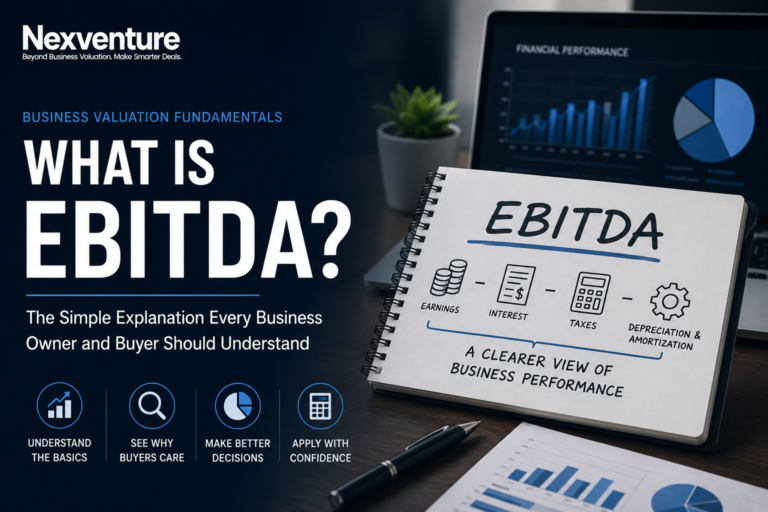
- ✅ Lesson 2 — What Is EBITDA?
- ✅ Lesson 3 — What Is Seller’s Discretionary Earnings?
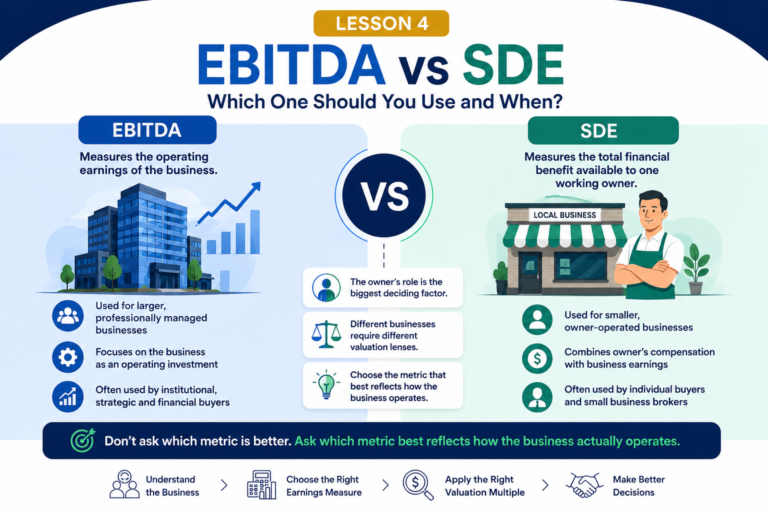
- ✅ Lesson 4 — EBITDA vs SDE
- ✅ Lesson 5 — Understanding Valuation Multiples
- ✅ Lesson 6 — Understanding Add-Backs
- ✅ Lesson 7 — What Is Goodwill?
- ⬜ Lesson 8 — Understanding Working Capital (Current Lesson)
🧠 You’ve Completed the Fundamentals
You now have the foundation needed to understand the major building blocks of private-business valuation: earnings, normalization, valuation multiples, goodwill, and working capital.
From here, future lessons can build on these fundamentals with deeper topics around valuation, buyer analysis, due diligence, deal structure, negotiation, and preparing a business for sale.
Bringing It Together
Working capital is a fitting place to finish our first Business Valuation Fundamentals series because it connects business valuation with the practical reality of completing a transaction.
Throughout these lessons, we’ve built the valuation process one concept at a time.
We started by understanding that businesses are not valued using one universal formula.
We then explored EBITDA and SDE to understand how buyers measure the earning power of different types of businesses.
We learned how add-backs can be used to normalize those earnings when appropriate.
We explored valuation multiples and why buyers may pay different amounts for businesses with similar earnings.
We looked at goodwill to understand some of the intangible value behind an established business.
And now we’ve seen how working capital can affect what actually needs to remain in the business when ownership changes.
Understanding what a business is worth is only one part of understanding a business transaction. You also need to understand what is included in that value and how the economics of the deal move from valuation to closing.
That’s why a $3 million valuation does not necessarily mean a seller receives exactly $3 million at closing.
Cash, debt, working capital, transaction structure, financing, taxes, fees, and other negotiated terms can all affect the final economics of a transaction.
The better you understand these concepts before entering a transaction, the fewer surprises you’re likely to encounter later.
TL;DR
- Working capital is generally calculated as current assets minus current liabilities.
- Working capital helps support the short-term operating cycle of a business while money moves between customers, inventory, suppliers, employees, and other expenses.
- The working capital definition used in a business sale may differ from the basic accounting calculation.
- Cash, debt, taxes, and certain other balances may be excluded depending on the transaction.
- Normalized working capital attempts to estimate the level of operating working capital normally required by the business.
- A working capital target or peg is an agreed amount against which actual closing working capital may be compared.
- If closing working capital is below the target, the seller’s proceeds may be reduced under the purchase agreement. If it is above the target, an upward adjustment may apply.
- A cash-free, debt-free transaction does not necessarily mean the buyer receives the business without operating working capital.
- Inventory may be included in working capital or treated separately depending on the transaction structure.
- Positive working capital isn’t automatically good, and negative working capital isn’t automatically bad. The appropriate level depends on the business model and operating cycle.
- The headline valuation and the seller’s final proceeds are not necessarily the same number.
Common Questions
What is working capital?
Working capital is generally calculated as current assets minus current liabilities. It helps indicate the short-term resources available to support a company’s operating obligations, although the definition used in a business transaction may include or exclude specific accounts.
What is normalized working capital?
Normalized working capital is an estimate of the level of operating working capital reasonably required to support a business under normal conditions. Historical balances, seasonality, growth, unusual periods, and other factors may be considered when determining an appropriate level.
What is a working capital target or peg?
A working capital target or peg is an amount agreed between the buyer and seller that represents the working capital expected to be delivered with the business. Actual working capital at closing may then be compared with this target.
Can working capital affect the purchase price?
Yes. If a transaction includes a working capital adjustment, a shortfall below the agreed target may reduce the seller’s proceeds, while an excess above the target may increase them, depending on the terms of the purchase agreement.
Does cash count as working capital in a business sale?
Not necessarily. Cash is a current asset under the basic accounting calculation, but many private-company transactions exclude cash from the working capital definition. The purchase agreement should specify exactly how cash is treated.
Is inventory included in working capital?
Often, but not always. Inventory may be included in operating working capital or handled separately depending on the type of business and transaction structure. Buyers may also review inventory for obsolescence, condition, quantity, and saleability.
What does cash-free, debt-free mean?
In simplified terms, a cash-free, debt-free transaction generally means enterprise value is negotiated separately from cash and debt. The exact treatment of cash, debt, debt-like items, and other balances depends on the purchase agreement.
Is negative working capital always bad?
No. Negative working capital can indicate liquidity problems in some businesses, but it can also be normal for business models that collect from customers quickly while paying suppliers later. Working capital should always be evaluated in the context of the business and its operating cycle.
Why should sellers understand working capital before going to market?
Working capital can affect transaction negotiations and final proceeds. Understanding historical working capital patterns, seasonality, account definitions, and normal operating requirements can help sellers evaluate proposed deal terms and reduce surprises later in the transaction.
Make better valuation decisions with confidence.
Nexventure combines valuation analysis, buyer perspective, risk assessment, and practical business intelligence to help owners, buyers, sellers, and advisors understand how businesses are evaluated and what truly drives business value.
Start Your Free Business Valuation