What Is Goodwill in Business Valuation? Understanding the Value Beyond Physical Assets
Learn what business goodwill means, where it comes from, why buyers may pay for it, and what makes goodwill valuable and transferable when a business is sold.
Lesson 7: Understanding Business Goodwill
In this lesson, you’ll learn why a business can be worth much more than the equipment, inventory, and other physical assets it owns—and what buyers are really paying for when that additional value is called goodwill.
Introduction
Imagine looking at a successful business and adding up everything you can physically see.
There may be equipment, furniture, inventory, computers, vehicles, and other assets.
But those assets alone often don’t explain why the business is valuable.
The business may also have loyal customers, a trusted reputation, trained employees, established systems, strong supplier relationships, recurring revenue, a recognizable brand, and years of operating history.
You can’t necessarily touch those things.
But they can have real economic value.
That’s where the idea of goodwill becomes important.
Key Insight
A buyer isn’t necessarily purchasing only the assets inside a business. They’re also paying for the advantages that allow the business to continue attracting customers and generating earnings.
What Is Business Goodwill?
In simple terms, goodwill represents value connected to the intangible advantages of an established business.
These advantages can help the business attract customers, generate earnings, compete effectively, and continue operating successfully after ownership changes.
For example, consider a profitable local service business.
Its physical assets might include some computers, tools, vehicles, and office equipment.
But a buyer may also be acquiring:
- An established customer base.
- A recognizable name in the market.
- Years of positive reviews and reputation.
- Experienced employees.
- Documented operating systems.
- Supplier and referral relationships.
- Recurring or repeat business.
Those advantages can help explain why someone may be willing to pay more for an established operating business than simply buying similar equipment and starting from zero.
Business Translation
Goodwill helps explain the value of what has already been built—the relationships, reputation, systems, customer behaviour, and other advantages that would take a new competitor time, money, and effort to recreate.
Tangible Value vs Intangible Value
One of the easiest ways to understand goodwill is to first separate tangible and intangible sources of business value.
Tangible Assets
Tangible assets are things that physically exist and can generally be identified separately.
Depending on the business, these might include:
- Equipment
- Vehicles
- Furniture
- Inventory
- Machinery
- Computers
- Real estate, when included in the transaction
Intangible Value
A successful operating business can also have important sources of value that aren’t physical.
These may include things such as:
- Brand recognition
- Reputation
- Customer relationships
- Supplier relationships
- Operating systems and processes
- Workforce knowledge and experience
- Recurring customer behaviour
- Market presence
Important Distinction
Not every intangible asset is automatically goodwill. Some intangible assets—such as certain contracts, trademarks, licenses, or customer-related assets—may be separately identifiable. Goodwill generally represents the additional intangible value that isn’t separately identified in the same way.
You don’t need to become an accountant to understand the distinction.
For valuation purposes, the important idea is that a business can create economic value through assets and advantages that don’t appear as physical property.
Why Does Goodwill Exist?
Starting a business from scratch takes time.
A new owner may need to find customers, establish credibility, hire employees, develop processes, build supplier relationships, generate reviews, and create awareness in the market.
An established business may already have much of that infrastructure in place.
That’s economically useful to a buyer.
Instead of beginning with an empty operation, the buyer may be stepping into a business that already has customers, employees, systems, relationships, and an established ability to generate earnings.
☕ Think About It This Way
Suppose the equipment inside a business could be purchased for $150,000.
But the established business consistently generates healthy earnings because it has loyal customers, experienced staff, proven systems, and a strong reputation.
A buyer may reasonably value the operating business at considerably more than $150,000.
The buyer isn’t paying extra because the equipment somehow became more valuable.
They’re paying for an established business capable of producing economic benefits.
Key Insight
Goodwill becomes valuable when the advantages built by the existing business can continue creating benefits for a buyer after the transaction.
Examples of Business Goodwill
Goodwill can come from many different parts of a business.
The exact sources will vary by industry, but common examples include:
- A strong local or industry reputation.
- Long-standing customer relationships.
- Repeat and recurring revenue.
- A recognizable brand.
- Positive online reviews.
- Experienced employees and management.
- Documented systems and operating procedures.
- Established supplier relationships.
- Referral networks.
- Favourable market position.
None of these automatically guarantees strong goodwill.
What matters is whether they help the business generate earnings and whether those advantages are likely to continue after the ownership changes.
Key Insight
Goodwill is strongest when the value belongs to the business itself rather than being tied mainly to the current owner.
Personal Goodwill vs Business Goodwill
This distinction is especially important in owner-operated businesses.
Some of the value in a business may come from the company itself. Some may come from the personal reputation, relationships, knowledge, or involvement of the owner.
Personal Goodwill
Personal goodwill is value that is closely connected to a specific individual.
Examples might include:
- Customers who work with the business mainly because of the owner’s personal reputation.
- Important relationships maintained only by the owner.
- Technical or professional knowledge that has not been transferred to employees.
- Sales that depend heavily on the owner’s personal involvement.
This can create risk for a buyer.
If the owner leaves and customers, relationships, or knowledge leave with them, part of the value may not transfer successfully.
Business or Enterprise Goodwill
Business goodwill is value that is more closely attached to the company and can continue even after the current owner steps away.
Examples may include:
- A strong company brand rather than only the owner’s personal name.
- Customer relationships managed across the organization.
- A capable management team.
- Documented systems and procedures.
- Recurring contracts or repeat customer behaviour.
- A trained workforce that can operate without constant owner involvement.
Business Translation
If customers are loyal to you personally, the goodwill may be difficult to transfer.
If customers are loyal to the business, its team, systems, brand, and service experience, the value is more likely to remain after you leave.
Why Transferability Matters
Buyers don’t only ask whether goodwill exists.
They also want to know:
“Will this value still exist after the seller is gone?”
This is the idea of transferability.
A business may have excellent relationships, loyal customers, and a great reputation today. But if all of those depend entirely on the current owner, a buyer may see more risk.
On the other hand, goodwill may be more transferable when:
- Customers interact with multiple employees.
- The company brand is stronger than the owner’s personal identity.
- Important processes are documented.
- Employees understand how the business operates.
- Customer information and relationships are maintained in business systems.
- Sales and service do not depend entirely on one person.
Key Insight
A business can have a lot of goodwill but still receive a weaker valuation if buyers believe that goodwill will disappear when the owner leaves.
What Creates Strong Goodwill?
Strong goodwill is usually built over time rather than created by a single factor.
Buyers may feel more confident in goodwill when the business has several of the following characteristics.
1. A Strong Reputation
A business that is trusted by customers and known for consistent service may have an advantage that would take a new competitor years to build.
Reviews, referrals, repeat customers, and market recognition can all provide evidence of that reputation.
2. Repeat or Recurring Revenue
Businesses with recurring contracts, subscriptions, maintenance agreements, or strong repeat purchasing patterns may provide buyers with greater confidence about future revenue.
Predictability can make the customer base more valuable than a business that must constantly replace lost sales.
3. Customer Diversification
A broad customer base can make goodwill more resilient.
If a large percentage of revenue depends on one or two customers, the customer relationships may still be valuable—but buyers may apply more caution because losing one relationship could significantly affect earnings.
4. Strong Systems and Processes
Documented systems help turn knowledge from something stored in the owner’s head into something that belongs to the business.
Standard operating procedures, customer management systems, training processes, financial controls, and other documented workflows can all make the business easier to transfer.
5. A Capable Team
Experienced employees and management can create significant value when they allow the business to continue operating without constant owner involvement.
Buyers may feel more confident when important customer, operational, and management responsibilities are spread across a team rather than concentrated with the seller.
6. A Recognizable Brand
A brand can represent years of customer awareness, trust, reputation, and market positioning.
The stronger the company identity is independent of the owner, the more transferable that advantage may be.
Pro Tip
If you’re preparing a business for sale, look for ways to move value from the owner to the organization. Strengthening systems, customer relationships, management, documentation, and the company brand can make goodwill easier for a buyer to understand and trust.
What Can Weaken Goodwill?
Goodwill can also be fragile.
A business may look successful today but still carry risks that make buyers less confident about whether its intangible value will continue.
Common concerns include:
- High dependence on the owner.
- Revenue concentrated among a small number of customers.
- Poor documentation.
- Weak systems and processes.
- High employee turnover.
- Negative reviews or reputation problems.
- Customer relationships controlled mainly by one individual.
- Declining repeat business.
- Important knowledge that has not been transferred.
Common Mistake
Business owners sometimes assume that years in business automatically create strong goodwill.
Longevity can certainly help, but buyers still want evidence that the business’s reputation, relationships, systems, and earning power are likely to continue after the transaction.
A company can have operated successfully for twenty years and still be difficult to transfer if nearly everything depends on the owner.
How Buyers Think About Goodwill
Sellers often think about goodwill in terms of everything they have built over the years.
Buyers tend to look at it from a slightly different perspective.
They want to understand whether those advantages will continue producing economic benefits after they take ownership.
A buyer may ask questions such as:
- Will customers remain after the owner leaves?
- How much revenue comes from repeat or recurring customers?
- Are important customer relationships tied to the company or the owner?
- Can employees operate the business without the seller?
- Are key processes documented?
- How strong is the company’s reputation?
- Is revenue diversified across enough customers?
- Are supplier and referral relationships transferable?
- What makes this business difficult for a competitor to recreate?
These questions help a buyer evaluate the quality, durability, and transferability of the goodwill they may be acquiring.
Key Insight
Buyers don’t pay for goodwill simply because a seller says it exists. They want evidence that the advantages behind that goodwill can continue creating value after the transaction.
A Simple Goodwill Valuation Example
Let’s use a simplified example to see how goodwill can appear in a business transaction.
Suppose a buyer determines that an operating business is worth $1,000,000.
As part of the transaction analysis, assume the identifiable net assets being acquired are valued at $400,000.
| Item | Amount |
|---|---|
| Business Purchase Price | $1,000,000 |
| Identifiable Net Assets | $400,000 |
| Remaining Value | $600,000 |
In a simplified example, the remaining $600,000 may represent goodwill if there are no other separately identifiable assets or adjustments that need to be recognized.
Why would a buyer pay $1,000,000 for a business with only $400,000 of identifiable net assets?
Because the buyer isn’t purchasing a collection of assets sitting in a room.
They may also be acquiring an established operation with customers, employees, systems, reputation, relationships, and the ability to generate earnings.
☕ The Important Part
The $600,000 isn’t automatically a separate pile of money called goodwill.
In a real transaction, the purchase price may need to be allocated among several identifiable tangible and intangible assets before the residual amount is treated as goodwill.
The example is simply showing why the value of an operating business can exceed the value of its identifiable net assets.
Common Goodwill Mistakes
Goodwill can feel subjective, which makes it easy to misunderstand.
Common Mistake #1: Assuming Goodwill Is Just Reputation
Reputation can contribute to goodwill, but goodwill can reflect much more than reputation alone.
Customer relationships, systems, workforce capabilities, recurring business, market position, and other intangible advantages may all contribute to the value of an established operation.
Common Mistake #2: Treating All Intangible Value as Goodwill
Not every intangible asset is goodwill.
Certain trademarks, contracts, licenses, customer-related assets, technology, or other intangible assets may be separately identifiable depending on the transaction and applicable accounting or valuation requirements.
Common Mistake #3: Assuming Years in Business Automatically Create Goodwill
A long operating history can contribute to reputation and customer confidence, but age alone doesn’t determine goodwill.
Buyers care about what the business has built during those years and whether that value is likely to continue.
Common Mistake #4: Ignoring Owner Dependence
A highly successful business can still have transferability problems if its customers, knowledge, sales, and operations depend heavily on the owner.
Buyers may discount the value they place on those advantages if they believe they could disappear when the seller leaves.
Common Mistake #5: Assigning an Arbitrary Dollar Amount to Goodwill
A seller shouldn’t simply decide that the business has “$500,000 of goodwill” because of its reputation or years of operation.
Goodwill needs to make sense within the overall economics, valuation, assets, earnings, and transaction structure of the business.
Common Mistake #6: Assuming Goodwill Is Guaranteed to Transfer
Goodwill can lose value if customers leave, key employees depart, important relationships end, or the business struggles without the seller.
That’s why transition planning and transferability matter so much during a business sale.
Pro Tip
Instead of trying to convince a buyer that your business has “a lot of goodwill,” show them the evidence behind it: customer retention, recurring revenue, reviews, documented systems, management depth, referral sources, employee stability, and reduced owner dependence.
A Practical Reflection
Think About Your Business
Imagine you stopped working in your business tomorrow.
What would remain?
Would customers continue buying from the company?
Would employees know how to run the day-to-day operation?
Would important customer and supplier relationships continue without you?
Would the company’s reputation and brand still bring in new business?
Are important processes documented, or do they mostly exist in your head?
The more value that remains with the organization rather than leaving with the owner, the more transferable the business may be.
🗣 Business Translation
If someone says:
“A large part of this business’s value is goodwill.”
What they are really saying is:
“The business is worth more than its identifiable net assets because it has established advantages—such as customer relationships, reputation, systems, brand strength, and other intangible value—that help it generate earnings.”
But the existence of goodwill doesn’t automatically mean all of that value will transfer to a buyer.
Buyers will still want to understand how much of that value belongs to the business itself and how much depends on the current owner.
🎯 Before You Move On
If you can answer these questions, you’ve understood the core ideas from this lesson.
1. What does goodwill represent in a business valuation or transaction?
2. Why can an operating business be worth more than its identifiable net assets?
3. What is the difference between personal goodwill and business goodwill?
4. Why does transferability matter when a buyer evaluates goodwill?
5. What can a business owner do to make goodwill less dependent on them personally?
📚 Continue Learning
Every lesson builds on the previous one. Continue expanding your understanding of business valuation one concept at a time.
- ✅ Lesson 1 — How Businesses Are Really Valued
- ✅ Lesson 2 — What Is EBITDA?
- ✅ Lesson 3 — What Is Seller’s Discretionary Earnings?
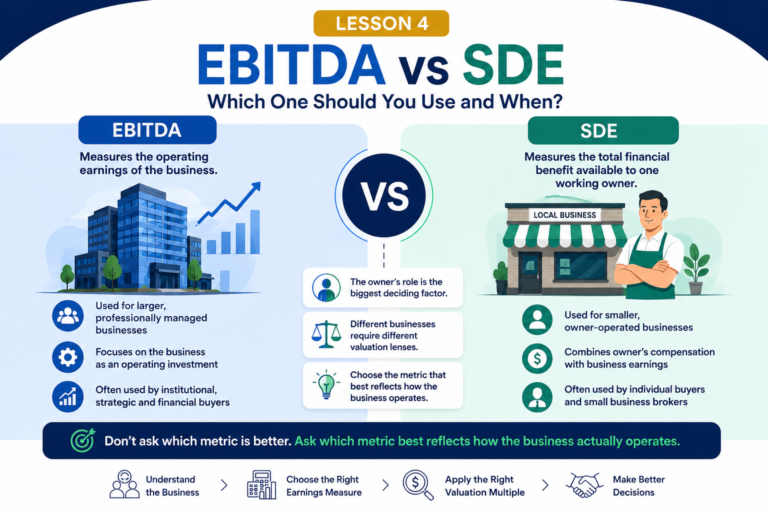
- ✅ Lesson 4 — EBITDA vs SDE
- ✅ Lesson 5 — Understanding Valuation Multiples
- ✅ Lesson 6 — Understanding Add-Backs
- ⬜ Lesson 7 — What Is Goodwill? (Current Lesson)
- ⬜ Lesson 8 — Understanding Working Capital
🧠 Coming Up Next
Now that you understand why a business can be worth more than its physical and identifiable assets, the next lesson explores working capital—what it means, why buyers care about it, and how it can affect a business transaction.
Bringing It Together
Goodwill becomes easier to understand when we connect it with everything we’ve learned throughout this series.
A business generates earnings, which may be measured using SDE or EBITDA depending on the type of business and the purpose of the analysis.
Those earnings may then be normalized using appropriate add-backs.
A valuation multiple may be applied to those normalized earnings to estimate what the operating business could be worth.
But what is the buyer actually paying for?
Part of the value may come from tangible assets such as equipment and inventory. Other identifiable assets may also contribute value.
And part of the value may come from the intangible advantages that allow the established business to continue generating economic benefits.
Earnings tell us what the business produces. Goodwill helps us understand some of the intangible value behind an established business’s ability to keep producing those benefits.
This is also why transferability matters so much.
If customers, systems, employees, reputation, and relationships can continue without the seller, a buyer may have greater confidence in the value they’re acquiring.
If those advantages disappear when the owner leaves, the buyer may view the business very differently.
TL;DR
- Goodwill represents intangible value associated with advantages of an established business that can contribute to its ability to generate economic benefits.
- Goodwill helps explain why an operating business may be worth more than the value of its identifiable net assets.
- Reputation, customer relationships, recurring business, systems, workforce capabilities, brand strength, and market presence can all contribute to intangible business value.
- Not every intangible asset is goodwill. Some intangible assets may be separately identifiable.
- Personal goodwill is closely connected to the individual owner, while business or enterprise goodwill is more closely attached to the organization.
- Transferability matters because buyers want to know whether the value they’re acquiring will remain after the seller leaves.
- High owner dependence, customer concentration, poor documentation, weak systems, and reputation problems can reduce buyer confidence in goodwill.
- Owners can strengthen transferability by building management depth, documenting processes, spreading customer relationships across the organization, and reducing dependence on themselves.
- Goodwill shouldn’t simply be assigned an arbitrary dollar amount because a business has operated for many years.
- Ultimately, strong goodwill is valuable when the advantages behind it can continue benefiting the business under new ownership.
Common Questions
What is goodwill in business valuation?
Goodwill generally represents intangible value associated with an established business that isn’t separately identified in the same way as its tangible and identifiable intangible assets. It can reflect advantages such as reputation, customer relationships, systems, workforce capabilities, and other factors that help the business generate economic benefits.
Why would a buyer pay more than the value of a business’s physical assets?
A buyer may be acquiring much more than equipment, inventory, and other physical assets. An established business may already have customers, employees, systems, reputation, relationships, market presence, and an ability to generate earnings that would take significant time and investment to recreate from scratch.
Is goodwill the same as brand value?
No. Brand strength can contribute to the intangible value of a business, but goodwill is a broader concept. Depending on the circumstances, certain brands, trademarks, customer relationships, contracts, or other intangible assets may also be separately identifiable rather than simply being treated as goodwill.
What is the difference between personal goodwill and business goodwill?
Personal goodwill is closely connected to the reputation, relationships, skills, or involvement of a specific owner. Business or enterprise goodwill is more closely attached to the company itself through its brand, customer relationships, employees, systems, processes, and other organizational advantages.
Why does owner dependence affect goodwill?
If customers, sales, knowledge, relationships, or daily operations depend heavily on the owner, buyers may worry that some of that value will disappear when the seller leaves. Reducing owner dependence can make the business’s intangible value more transferable.
Can recurring revenue contribute to goodwill?
Recurring contracts, subscriptions, repeat purchasing behaviour, and other predictable customer relationships can contribute to the strength of an established business. Buyers may value this predictability because it can provide greater confidence about future revenue, although the specific treatment depends on the valuation and transaction circumstances.
How can a business owner strengthen transferable goodwill?
Owners can work to reduce personal dependence by documenting processes, developing management and employees, strengthening the company brand, distributing customer relationships across the organization, improving customer retention, and making important business knowledge easier to transfer.
Does every business have goodwill?
Not necessarily. Whether meaningful goodwill exists depends on the economics of the business, its assets, earnings, reputation, relationships, systems, market position, and other factors. A business can also have intangible advantages that are weak, highly owner-dependent, or difficult to transfer.
What should I learn after understanding business goodwill?
Continue with Lesson 8 to understand working capital, why buyers care about it, and how working capital can affect the economics of a business transaction.
Make better valuation decisions with confidence.
Nexventure combines valuation analysis, buyer perspective, risk assessment, and practical business intelligence to help owners, buyers, sellers, and advisors understand how businesses are evaluated and what truly drives business value.
Start Your Free Business Valuation