How Much Is My Small Business Worth in Canada? A Practical 2026 Guide for Owners Thinking Ahead
A calm, practical guide to understanding small business valuation, SDE, EBITDA, goodwill, transferability, buyer risk, and why a simple online calculator usually does not tell the full story.
Introduction
At some point, almost every business owner asks the same question.
Maybe it happens after a long week. Maybe after a buyer casually asks if you would ever consider selling. Maybe after your accountant mentions retirement planning. Or maybe you are just tired, and for the first time in years, you start wondering what the business you built might actually be worth.
It sounds like a simple question: How much is my business worth?
But for most small business owners in Canada, the answer is not simple at all.
One person tells you businesses sell for three times profit. Someone else says five times EBITDA. A broker gives you a number that feels exciting. An online business valuation calculator gives you a range in thirty seconds. Then a serious buyer looks at the same business and starts asking about customer concentration, owner dependency, lease terms, financial cleanup, recurring revenue, staff stability, and whether the business can actually run without you.
That is usually where the confusion starts.
In my experience, most owners are not looking for a fantasy number. They want a number they can understand. A number that feels grounded. A number that helps them make better decisions before they sell, retire, transition, or spend another few years improving the company.
That is the right way to look at valuation.
Let’s break this down in a practical way, without pretending valuation is just one formula.
What “business worth” really means
A small business is not worth one fixed number in the way a bank account has a fixed balance.
Business value is usually a range. And that range depends on the buyer, the business quality, the risk, the market, the deal structure, the financial proof, and the confidence someone has that the business can keep producing income after the sale.
That last part matters more than people think.
A buyer is not just buying your past results. They are buying the belief that those results can continue after you leave.
So when someone asks, “How much is my small business worth?” the better question is often:
How much would a qualified buyer reasonably pay for this business, based on its cash flow, risk, transferability, and future confidence?
That is a very different question.
SDE vs EBITDA: the two income numbers owners should understand
Most small business valuation conversations eventually come back to earnings.
For smaller owner-operated businesses, the most common starting point is often SDE, or Seller’s Discretionary Earnings.
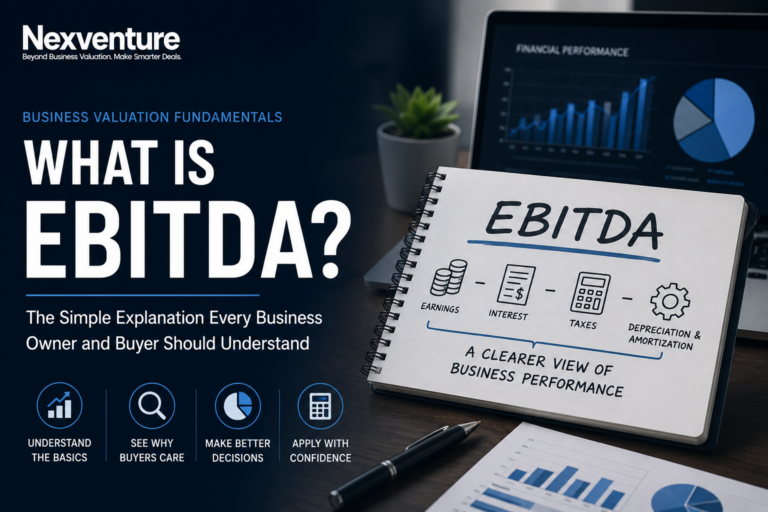
For larger or more management-run businesses, buyers and advisors often look more closely at EBITDA, which stands for earnings before interest, taxes, depreciation, and amortization.
The difference matters.
What is SDE?
SDE tries to estimate the total financial benefit available to one full-time owner-operator.
It usually starts with profit and then adds back certain owner-related expenses, discretionary expenses, one-time costs, and sometimes the owner’s salary, depending on how the business is structured.
For example, if a small service business shows $120,000 in net income but also pays the owner $80,000, and has $10,000 in legitimate one-time expenses, the SDE may be closer to $210,000.
That does not automatically mean the business is worth $210,000. It means the business may be producing around that much economic benefit for an owner-operator before applying a valuation multiple.
What is EBITDA?
EBITDA is more common when the business has management depth, cleaner financials, stronger systems, and less reliance on one owner.
A buyer using EBITDA is usually asking:
“What does this business produce as an operating company after normalizing certain accounting items?”
EBITDA is often used in lower mid-market and larger transactions. It can also appear in smaller deals when the buyer is more sophisticated, especially if they are comparing multiple acquisition opportunities.
This is why the quality of the earnings number matters. If the starting number is messy, the final valuation range will be messy too.
How valuation multiples actually work
Once earnings are normalized, many small businesses are valued using a multiple.
A simple version looks like this:
Normalized earnings x valuation multiple = estimated business value
So if a business has $200,000 in SDE and a reasonable multiple is 2.5x, the estimated value may be around $500,000 before adjusting for working capital, debt, excess assets, inventory, deal structure, and other transaction-specific items.
But here is where many owners get tripped up.
The multiple is not random. It is not just an industry average. And it should not be copied from a business-for-sale listing you saw online.
A multiple reflects buyer confidence.
Higher confidence usually supports a stronger multiple. Lower confidence usually creates discount pressure.
What can increase the multiple?
- Clean and organized financials
- Low owner dependency
- Recurring or repeat revenue
- Stable margins
- Documented systems and processes
- Diverse customer base
- Reliable staff or management
- Clear growth opportunities
- Transferable goodwill
What can lower the multiple?
- Revenue tied heavily to the owner
- Messy bookkeeping
- One or two customers driving most revenue
- Declining sales
- Unclear margins
- Weak systems
- High staff turnover
- Unclear lease or supplier risks
- Growth that depends only on the current owner’s personal effort
I have seen businesses with similar profit levels receive very different buyer reactions. One feels clean, transferable, and easy to understand. The other feels uncertain. Same earnings, very different confidence.
That is why a business valuation calculator can be useful as a starting point, but it can also be misleading if it treats all businesses with the same profit as equally valuable.
Valuation is only part of the story. Two businesses can show similar revenue and profit, yet receive very different levels of buyer interest depending on financial clarity, owner dependency, systems, and transferability. If you are preparing for an eventual sale, this related guide may help: Why Some Businesses Sell Quickly While Others Sit on the Market for Months .
Goodwill: the part of value that is easy to overestimate
Goodwill is one of the most misunderstood parts of small business valuation.
Owners often think goodwill means reputation, brand name, years in business, loyal customers, and community trust. And yes, those things can matter.
But buyers look at goodwill differently.
A buyer usually wants to know whether the goodwill will stay with the business after the owner leaves.
That is the key.
Personal goodwill vs commercial goodwill
If customers come mainly because of you, your personality, your relationships, your reputation, or your technical skill, that may be personal goodwill.
Personal goodwill is harder to transfer.
Commercial goodwill is different. It belongs more clearly to the business itself. It may come from brand reputation, location, systems, staff, contracts, repeat customers, marketing channels, proprietary processes, or operational reliability.
Commercial goodwill is usually more valuable because a buyer can reasonably expect it to continue.
This could mean documenting processes, building a second layer of customer relationships, training staff, cleaning up CRM data, improving reporting, and making sure the business does not feel like it depends on one person remembering everything.
Not glamorous work. But often very valuable.
What buyers actually evaluate when valuing a business
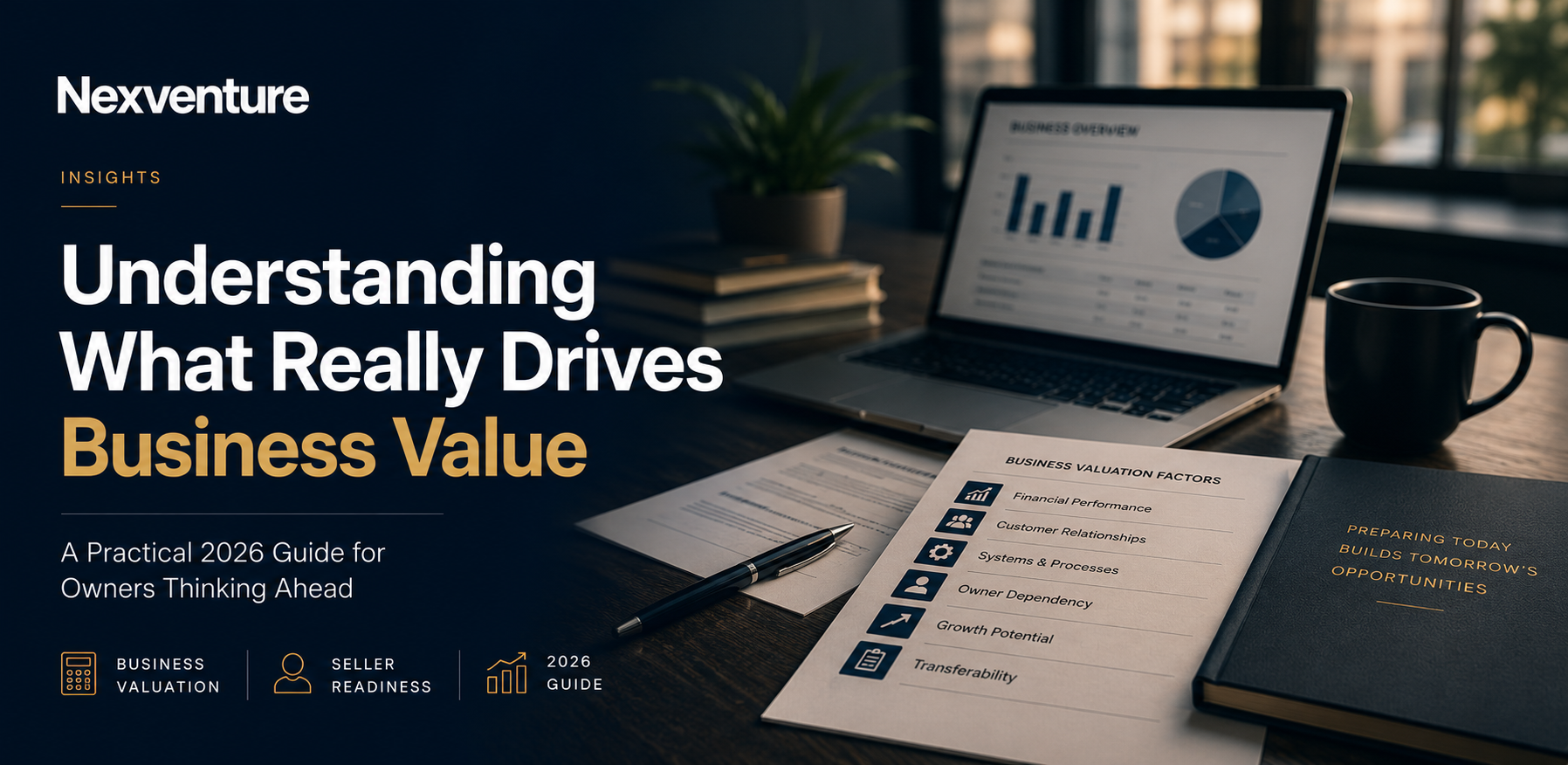
Many owners focus only on revenue or profit when estimating business value, but buyers usually evaluate much deeper operational and strategic factors. Things like transferability, customer concentration, recurring revenue quality, operational systems, and owner dependency can significantly influence how a business is perceived during a sale process.
If you want to better understand the core business valuation factors that may influence buyer perception and valuation confidence, it helps to look beyond simple industry multiples.
Another area many business owners underestimate is seller readiness. Even profitable businesses can face valuation pressure if operations depend too heavily on the owner or if financial reporting lacks clarity.
From the buyer side, valuation is also closely connected to perceived risk and long-term stability. Buyers often analyze operational structure, transition complexity, and overall buyer confidence before moving forward with serious acquisition discussions.
Curious how buyers may interpret your business?
Explore Nexventure’s AI-assisted business valuation and acquisition intelligence platform designed for buyers, sellers, and advisors.
Start Free ValuationBuyer risk: what buyers quietly worry about
Sellers usually focus on price.
Buyers focus on risk.
That difference explains a lot of the tension in small business sales.
A seller may say, “This business makes $250,000 a year.”
A buyer may quietly think:
- Will customers stay after closing?
- Can I replace the owner’s role?
- Are the financials reliable?
- Are employees likely to stay?
- Is revenue recurring or just relationship-based?
- Will suppliers continue on the same terms?
- How much working capital will I need?
- What problems are not obvious yet?
This is where buyer confidence becomes a valuation factor.
A buyer may still like the business. They may still make an offer. But if too many risks are unclear, they may lower the price, ask for seller financing, request a longer transition period, add earnout terms, or walk away during due diligence.
What I usually tell owners is simple:
The cleaner the story, the easier it is for buyers to trust the number.
Not a perfect story. No small business is perfect.
Just a story that makes sense.
Valuation is only one side of the equation. Buyer confidence and acquisition risk also heavily influence how businesses are perceived during a sale:
What buyers usually look beyond the numbers
Financial performance matters. Of course it does.
But in real acquisitions, buyers rarely look at profit alone.
In my experience, what often changes valuation conversations is everything surrounding the numbers:
- How dependent the business is on the owner
- Whether customers are likely to stay after transition
- How organized the operations feel
- Whether revenue appears stable and repeatable
- How strong the systems and processes are
- How easy the business looks to transfer
- Whether the financials create confidence or uncertainty
Two businesses can show similar profit and still feel completely different to a buyer.
One may feel organized, transferable, and lower risk. Another may feel heavily dependent on the owner with unclear operations behind the scenes.
That difference can influence negotiations, buyer confidence, deal structure, and ultimately valuation.
This is one reason modern valuation analysis has evolved beyond simple multiples alone.
Tools like Nexventure’s valuation intelligence platform are increasingly designed to help business owners understand not only estimated valuation ranges, but also the operational, financial, and transferability factors that buyers often evaluate during real acquisition discussions.
A practical reflection: valuation is not just math
Selling a business is rarely only financial.
For many owners, the business has been part of their identity for years. Sometimes decades. It paid the bills, supported the family, created jobs, carried stress, and probably took more evenings and weekends than anyone outside the business really understands.
So when someone gives a low valuation, it can feel personal.
But buyers are not usually trying to insult the owner. They are trying to price uncertainty.
That is why preparation changes the conversation.
If you wait until the month you want to sell, you may be stuck explaining problems instead of fixing them. But if you start one to three years earlier, you can improve financial clarity, reduce owner dependency, strengthen systems, organize documents, and make the business feel more transferable.
A lot of owners wait too long before preparing. Not because they are careless. Usually because they are busy running the business.
Understandable.
But still costly sometimes.
Canadian and cross-border valuation context
If you are valuing a business in Canada, the core valuation logic is similar to what buyers use across North America.
Cash flow matters. Risk matters. Transferability matters. Financial proof matters.
There can be differences in tax treatment, legal structure, financing conditions, local buyer demand, lease norms, and industry expectations. A Canadian small business may also attract buyers from different provinces or, in some cases, cross-border interest from the United States.
That does not mean every Canadian business should be valued exactly like a US business. It means the broad decision logic is similar, while the details still need local judgment.
This is also why a valuation for small business owners should not feel like a black box. You should be able to understand the major assumptions behind the valuation range.
How to improve your business valuation before selling
Improving business value does not always mean growing revenue at any cost.
Sometimes the better move is making the business cleaner, safer, and easier to transfer.
Here are the areas I would usually look at first.
1. Clean up financials
Buyers trust clear numbers. If your profit and loss statements are messy, personal expenses are mixed in, or add-backs are hard to explain, buyers may discount the business even if the earnings are real.
2. Reduce owner dependency
If everything runs through you, the business may feel risky. Start documenting processes. Delegate customer relationships. Train staff. Build repeatable systems.
3. Improve revenue quality
Recurring revenue, repeat customers, contracts, subscriptions, maintenance plans, and diversified accounts can all improve buyer confidence.
4. Strengthen operational systems
A buyer wants to see how the business works. CRM, reporting, checklists, SOPs, job tracking, inventory systems, and clear workflows can all make the business easier to understand.
5. Identify buyer risk before buyers do
This part is uncomfortable, but useful. Look at your business the way a skeptical buyer would. Customer concentration, lease risk, employee dependency, supplier reliance, margin decline, poor documentation. Find these before due diligence.
Bringing it all together
Your business value is not just revenue. It is not just profit. And it is definitely not just a quick multiple from an online calculator.
A thoughtful valuation looks at cash flow, risk, goodwill, transferability, buyer confidence, financial clarity, and the likelihood that the business can continue performing after the sale.
If you are thinking about selling, even quietly, the best thing you can do is start early.
Not because you need to rush into the market.
Because getting prepared early usually gives you more options later.
And in a business sale, options matter.
TLDR: If you remember nothing else, remember this:
- Your business is usually worth a range, not one perfect number.
- SDE is often used for smaller owner-operated businesses, while EBITDA is more common for larger or more management-run businesses.
- Valuation multiples are influenced by buyer confidence, not just industry averages.
- Goodwill is more valuable when it can transfer to the buyer after you leave.
- Owner dependency, messy financials, and customer concentration can reduce valuation.
- Preparing one to three years before selling can improve clarity, confidence, and negotiating position.
FAQ
How do I know if my business is valued using SDE or EBITDA?
Smaller owner-operated businesses are often valued using SDE, while larger or more management-run businesses usually lean toward EBITDA. The deciding factor is often how dependent the business is on the owner personally.
What is a typical valuation multiple for a small business in Canada?
There is no universal number. Some businesses may sell for under 2x earnings, while others can justify much higher multiples. Industry, risk, recurring revenue, systems, and buyer confidence all influence the final range.
Can a business have strong revenue but still receive a low valuation?
Yes. Revenue alone does not guarantee a strong valuation. Buyers also look at profitability, customer concentration, owner dependency, operational systems, and whether the business feels transferable after the owner leaves.
How early should I prepare my business before selling?
Ideally one to three years earlier if possible. That gives you time to improve financial organization, reduce operational risk, strengthen systems, and improve buyer confidence before going to market.
What makes buyers feel more confident about a business?
Clear financials, organized operations, documented systems, stable revenue, and lower owner dependency usually help buyers feel more confident during acquisition discussions. Buyers generally pay more attention to risk and transferability than most owners initially expect.
What usually hurts a small business valuation the most?
Heavy owner dependency, messy financials, inconsistent earnings, customer concentration, weak systems, and unclear operations are some of the most common issues that reduce buyer confidence.
Get a clearer valuation starting point with Nexventure.
Nexventure helps you understand valuation range, buyer confidence, risk signals, and improvement opportunities before your next move.
Start Free Valuation