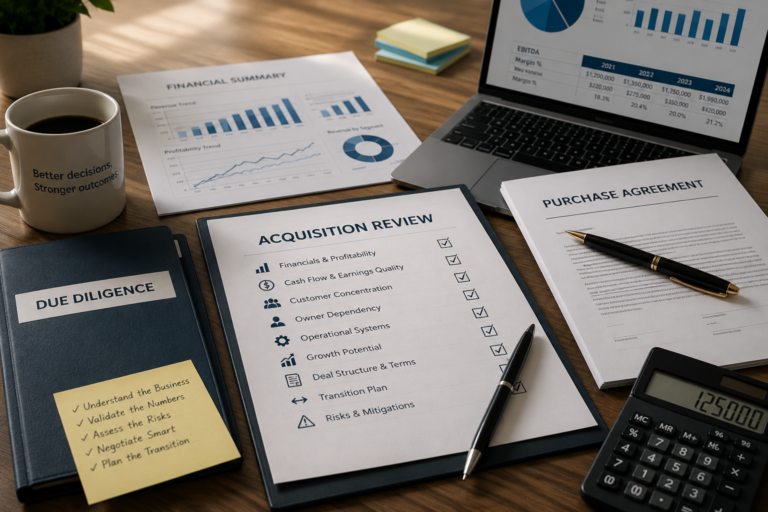
How to Evaluate a Business Acquisition Before You Make an Offer
A practical guide for buyers who want to look beyond the asking price and understand the real quality, risk, and opportunity behind a business acquisition.
Buying a business can feel exciting in a way that is hard to explain.
You are not starting from zero. There may already be customers, revenue, staff, systems, suppliers, equipment, brand recognition, and cash flow. Compared with building something from scratch, an acquisition can feel like a faster path.
And sometimes it is.
But this is also where many buyers get ahead of themselves.
They see the revenue. They see the profit. They imagine what they could improve. Better marketing, cleaner systems, stronger sales, maybe expansion into another location or market.
The opportunity feels obvious.
Then due diligence starts, and the business begins to look different. The owner is more involved than expected. One customer drives too much revenue. The financials need cleanup. Staff depend heavily on the seller. The growth story sounds good, but the systems behind it are thin.
I have seen this happen more often than people realize. The business was not necessarily bad. The buyer simply evaluated the opportunity too late, or too emotionally, or only through the asking price.
A good acquisition usually starts before the offer.
Let’s look at a practical way to evaluate an acquisition before you commit too much money, time, or emotion.
Start with the business, not the asking price
The asking price gets attention first. That is natural.
But the asking price is not the business.
It is the seller’s starting point. Sometimes it is thoughtful and well-supported. Sometimes it is based on a broker opinion, an industry rule of thumb, a retirement target, or simply what the owner hopes to receive.
Before asking “Is this price fair?” a buyer should ask a more useful question:
What kind of business am I actually looking at?
Is it an owner-operated job with cash flow attached? Is it a transferable business with systems? Is it a stable local company with limited growth? Is it a messy but fixable operation? Is it strategically valuable because of customers, location, licenses, staff, or market access?
These are different acquisition profiles.
Two businesses can have similar revenue and profit, but completely different risk and opportunity.
This is where tools like Nexventure’s buyer intelligence can help buyers organize the early thinking around valuation, risk, buyer confidence, and acquisition fit before going deeper into negotiations.
Understand the real earnings
Most acquisition conversations eventually come back to earnings.
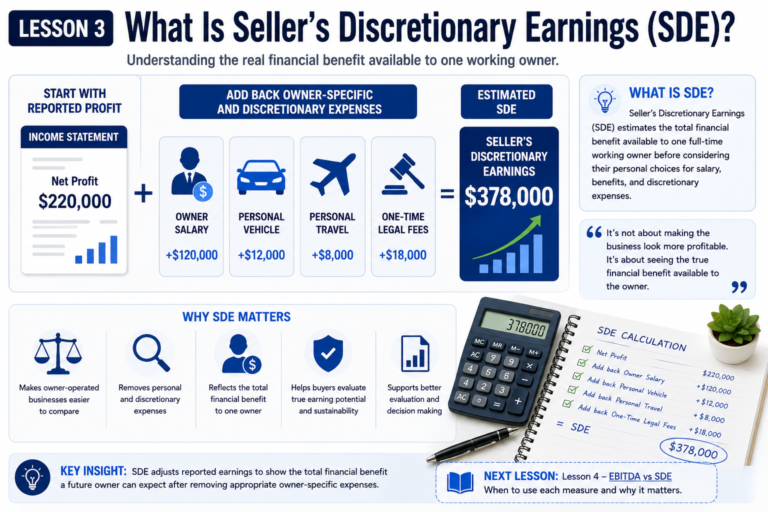
For smaller businesses, buyers often look at SDE, or Seller’s Discretionary Earnings. For larger or more management-run businesses, EBITDA may be more relevant.
But the real question is not just what number appears on the profit and loss statement.
The real question is:
What earnings can a buyer reasonably expect after the acquisition?
That means you need to understand add-backs, owner compensation, one-time expenses, discretionary spending, working capital needs, debt service, required reinvestment, and whether the current profit depends on the seller personally doing work that you will need to replace.
This part matters more than people think.
A business showing $250,000 in SDE may look attractive. But if the seller works 60 hours a week, handles key customer relationships, manages staff, does quoting, solves operational problems, and keeps the whole business moving, that cash flow may not be as passive or transferable as it looks.
You may need to hire a manager. You may need to pay yourself less than expected. You may need to invest in systems. You may need a longer seller transition.
None of that means the business is bad.
It just means the earnings need context.
If you want a deeper starting point on valuation thinking, this related guide may help: How Much Is My Small Business Worth in Canada?
Evaluate risk before upside
Buyers love upside.
Better marketing. New technology. Cost savings. Cross-selling. New locations. Stronger sales process. Improved pricing.
All of that can be real.
But experienced buyers usually look at risk before they give themselves credit for upside.
Why?
Because downside shows up quickly after closing. Upside usually takes time.
Before making an offer, look closely at:
- Customer concentration
- Owner dependency
- Quality of financial records
- Employee stability
- Supplier reliance
- Lease or location risk
- Recurring versus one-time revenue
- Margin trends
- Operational documentation
- Required capital investment after closing
Sometimes the numbers look fine, but the business still feels risky.
That feeling is worth paying attention to.
A business with clean systems, stable customers, documented operations, and lower owner dependency may deserve a stronger valuation multiple than a business with the same profit but more uncertainty.
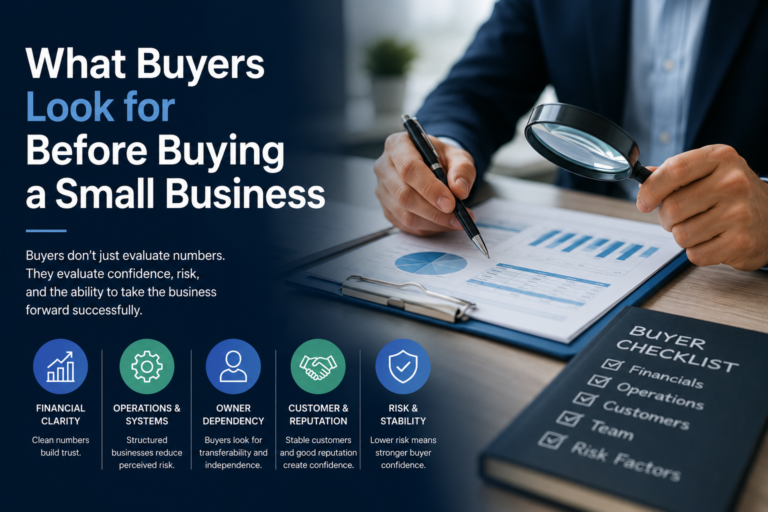
This is also why what buyers look for before buying a small business matters so much. The best buyers are not just trying to find a deal. They are trying to understand the risk they are inheriting.
Look for strategic fit, not just a “good business”
A business can be good and still not be right for you.
This is especially important for acquisition-minded entrepreneurs, operators, and strategic buyers.
The question is not only:
“Is this a decent business?”
The better question is:
“Does this business fit my strategy, skills, capital, timeline, and risk tolerance?”
A buyer with strong marketing experience may see opportunity in a business with weak lead generation. An operator may like a business with messy processes but strong demand. A strategic buyer may value customer access, territory, licenses, or staff more than a first-time buyer would.
Strategic fit can create value.
But be careful.
Do not confuse “I can improve this” with “this is a good acquisition.”
Improvement takes time, money, attention, and usually more patience than expected.
This is where acquisition strategy becomes practical. You are not buying an abstract opportunity. You are buying a real operating business with people, habits, customers, constraints, and history.
Think about deal structure before making the offer
Price gets most of the attention, but deal structure often matters just as much.
Sometimes more.
A buyer may be comfortable paying a stronger price if some risk is handled through seller financing, a transition period, working capital terms, holdbacks, earnouts, training support, or performance-based conditions.
A seller may also accept a slightly lower headline price if the offer feels cleaner, more certain, and easier to close.
This is where negotiation becomes less about “winning” and more about matching risk.
For example:
- If customer retention is uncertain, transition support may matter.
- If financial records need verification, due diligence conditions matter.
- If owner dependency is high, seller training and handover terms matter.
- If growth assumptions are aggressive, earnout structure may matter.
- If cash flow is stable, financing terms may become more attractive.
What I usually suggest is simple: do not separate valuation from risk.
The offer should reflect what you know, what you do not know yet, and what needs to be protected before closing.
If you are new to acquisitions, this article on costly mistakes first-time business buyers make is worth reading before you get too deep into a deal.
A practical reflection
There is a strange emotional pull when you find a business that seems promising.
You start picturing the future. You imagine the improvements. You see the possible growth. You may even feel like you found something other buyers missed.
That optimism can be useful. Buyers need some belief.
But optimism needs structure.
A good acquisition process slows you down just enough to see clearly. Not to kill the opportunity. Not to become overly negative. Just enough to separate what is proven from what is assumed.
In my experience, the best buyers are not the most aggressive buyers. They are the most disciplined ones.
They can still move quickly.
But they know what they are looking for.
Related Nexventure insights
If you are evaluating a business acquisition, these related guides can help you think through valuation, buyer risk, and deal readiness more clearly.
Bringing it all together
A business acquisition should not be evaluated only through the asking price.
The better approach is to understand the business behind the number.
What are the real earnings? How transferable is the operation? Where is the risk hiding? What does the seller still hold in their head? What would need to be fixed after closing? And does the business actually fit your strategy?
Good acquisitions usually come from understanding the business beyond the headline numbers.
The more clearly you can see the risk and opportunity before making an offer, the more intelligently you can negotiate.
TLDR: If you remember nothing else, remember this:
- Do not evaluate a business only by the asking price.
- Understand whether earnings are truly transferable after the seller leaves.
- Look at owner dependency, customer concentration, financial quality, and operational systems before getting excited about upside.
- A good business is not always a good acquisition for your strategy.
- Deal structure can protect both buyer and seller when risk is unclear.
- Strong buyers separate proven performance from assumptions.
- The best acquisition decisions are usually disciplined, not emotional.
FAQ
What should I check before making an offer on a business?
Start with financial quality, owner dependency, customer concentration, staff stability, recurring revenue, systems, lease terms, and whether the business can realistically transfer to a new owner.
How do I know if the asking price is reasonable?
Compare the asking price against normalized earnings, valuation multiples, business risk, transferability, market conditions, and deal structure. A price can look reasonable on paper but still be risky if the business depends too heavily on the seller.
What is the biggest risk when buying a small business?
One of the biggest risks is discovering after closing that the business relied more heavily on the seller than expected. Customer relationships, staff decisions, operations, and problem-solving may all depend on the owner.
Should I focus more on current profit or future upside?
Both matter, but current profit should be understood first. Future upside is valuable only if it is realistic, funded, and connected to your actual skills or strategic advantage.
Can deal structure reduce acquisition risk?
Yes. Seller financing, transition support, holdbacks, earnouts, and due diligence conditions can help align price with risk when certain parts of the business need more verification.
Evaluate the business before you make the offer.
Nexventure helps buyers understand valuation range, buyer confidence, risk signals, transferability, and acquisition readiness before moving deeper into a deal.
Explore Buyer Intelligence