EBITDA vs SDE: What’s the Difference and Which One Should You Use?
EBITDA and Seller’s Discretionary Earnings both help explain business profitability, but they are designed for different types of businesses. This lesson compares the two metrics, explains when each is commonly used, and shows why choosing the right one matters during business valuation.
Lesson 4: Understanding EBITDA vs SDE
By the end of this lesson, you should understand the difference between EBITDA and Seller’s Discretionary Earnings, which types of businesses commonly use each metric, why the owner’s role affects the calculation, and how buyers decide which measure provides the most useful view of business earnings.
By now, you have learned about two of the most common earnings measures used in business valuation: EBITDA and Seller’s Discretionary Earnings.
Both help buyers look beyond reported net profit.
Both attempt to provide a clearer picture of the financial performance of a business.
And both can play an important role when estimating business value.
But they are not interchangeable.
Imagine two companies operating in the same industry.
The first is a small HVAC business where the owner prepares estimates, manages employees, handles customer relationships, and solves daily operating problems.
The second is a larger HVAC company with a general manager, department supervisors, an established sales team, and systems that allow the business to operate without the owner’s daily involvement.
Both companies may generate similar annual earnings.
Yet buyers may evaluate them using different financial measures.
The owner-operated company may be analyzed using Seller’s Discretionary Earnings.
The professionally managed company may be analyzed using EBITDA.
The reason is not simply revenue, profit, or industry.
The difference is largely about what the owner does and whether the business requires that owner’s labour to continue producing its current results.
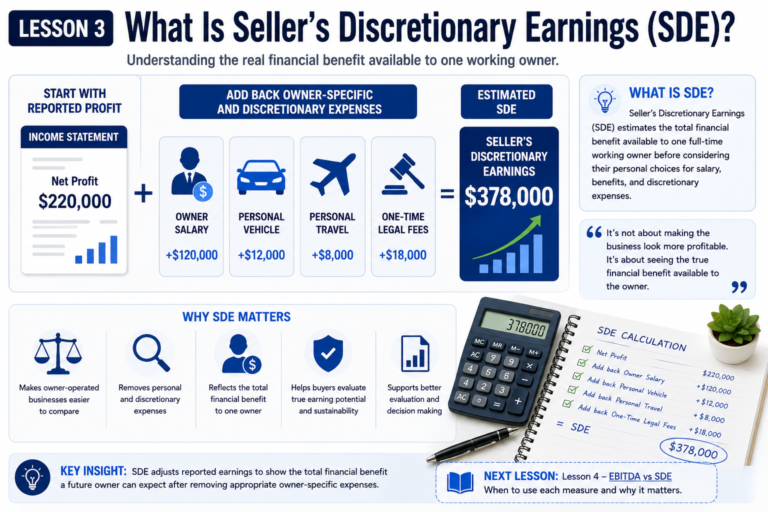
SDE estimates the total financial benefit available to one working owner.
EBITDA measures the operating earnings of the business before interest, taxes, depreciation, and amortization.
Choosing the wrong metric can create confusion, unrealistic valuation expectations, and misleading comparisons between businesses.
Throughout this lesson, we will compare EBITDA and SDE side by side, explain when each measure is commonly used, and show why the owner’s role is often the most important factor in deciding which metric makes sense.
Let’s begin with a simple comparison of what EBITDA and SDE are actually trying to measure.
EBITDA vs SDE at a Glance
EBITDA and SDE both start with the financial performance of the business.
The difference is what each measure is designed to represent.
| EBITDA | Seller’s Discretionary Earnings |
|---|---|
| Measures the operating earnings of the business. | Measures the total financial benefit available to one working owner. |
| Commonly used for larger or professionally managed businesses. | Commonly used for smaller, owner-operated businesses. |
| Usually treats management compensation as a normal operating expense. | Usually adds back one owner’s compensation. |
| Focuses on business performance independent of financing and certain accounting decisions. | Focuses on the economic benefit received by one active owner. |
| Often used by investors, private equity groups, lenders, and strategic buyers. | Often used by individual buyers, business brokers, and small business advisors. |
Neither measure is automatically better.
The correct metric depends on the type of business, the ownership structure, the management model, and what the buyer is trying to understand.
EBITDA measures the earnings of the business.
SDE measures the total financial benefit available to one working owner.
☕ Coffee Break
A simple way to remember the difference:
EBITDA asks: How profitable is the business before financing, taxes, depreciation, and amortization?
SDE asks: How much total financial benefit could one active owner receive from this business?
The Core Difference Between EBITDA and SDE
The biggest difference between EBITDA and SDE is the treatment of owner compensation.
SDE usually assumes that one owner will actively work in the business after the purchase.
Because that owner will receive the benefit of the company’s earnings and their own compensation, one owner’s salary and related benefits are generally added back.
EBITDA takes a different approach.
It attempts to measure the operating earnings of the business before financing, taxes, depreciation, and amortization.
If the company requires a general manager, chief executive, or other professional leadership to operate, the cost of that management is generally treated as a normal business expense.
This distinction matters because a buyer cannot usually remove a necessary management position without replacing the work somehow.
If the owner leaves, who will perform the owner’s job?
That is one of the most important questions in the EBITDA vs SDE comparison.
If the buyer plans to step into the owner’s role and work full time in the company, SDE may provide a useful picture of the total owner benefit.
If the buyer plans to remain passive and hire someone else to run the company, the cost of replacement management must usually be considered.
🧠 Did You Know?
The same business can sometimes be presented using both SDE and EBITDA, but the two figures answer different questions and may support different valuation approaches.
When Is SDE Commonly Used?
Seller’s Discretionary Earnings is most commonly used when evaluating smaller businesses where one owner is actively involved in daily operations.
In these businesses, the owner may handle sales, operations, employee management, customer relationships, scheduling, purchasing, and many other responsibilities.
The owner’s salary is not always treated like the salary of an independent professional manager.
Instead, it is often considered part of the total financial benefit available to the person who owns and operates the company.
SDE is commonly used for businesses such as:
- Local service companies.
- Small retail businesses.
- Independent restaurants.
- Owner-operated trades businesses.
- Small agencies and professional service firms.
- Franchises managed directly by the owner.
The business does not need to be extremely small for SDE to apply.
The more important question is whether one owner is actively performing work that contributes directly to the company’s results.
SDE is most useful when a buyer is expected to step into the current owner’s role and work in the business.
What does an SDE buyer usually expect?
A buyer relying on SDE is often purchasing both an investment and a full-time operating role.
They are not simply collecting profits from a passive asset.
They may be replacing the seller as the person who manages employees, makes decisions, builds relationships, and keeps the company moving each day.
That is why SDE combines the owner’s compensation with the underlying earnings of the business.
☕ Coffee Break
An SDE-based acquisition often means:
You are buying the business and the owner’s job.
That can still be a very attractive opportunity, but the buyer should understand how much work is required to produce the reported earnings.
When Is EBITDA Commonly Used?
EBITDA is more commonly used when the business operates independently of one owner’s daily labour.
These companies often have a professional management team, department leaders, documented systems, and employees who can continue operating the business after ownership changes.
The owner may still be involved in strategy, major decisions, or leadership.
But the company is not completely dependent on that person performing every important operating function.
EBITDA is commonly used for:
- Larger privately held companies.
- Professionally managed businesses.
- Companies acquired by private equity groups.
- Strategic acquisitions by larger competitors.
- Businesses with established management teams.
- Companies where ownership and daily management are separate.
EBITDA helps buyers evaluate the company’s operating performance before considering how the acquisition will be financed or how accounting policies affect reported earnings.
🧠 Did You Know?
A buyer using EBITDA generally expects the business to include the people and management structure needed to continue operating after the seller leaves.
What does an EBITDA buyer usually expect?
An EBITDA-based buyer is often purchasing a business that can function as an investment separate from the buyer’s own full-time labour.
The buyer may oversee strategy and performance without becoming the day-to-day operator.
Because professional management is usually required, management salaries remain part of the normal cost of running the business.
Removing those costs would overstate the earnings available to the buyer.
Why the Owner’s Role Matters So Much
The difference between EBITDA and SDE becomes much clearer when you stop looking only at the financial statements and begin examining what the owner actually does.
Consider an owner who works sixty hours per week.
They manage staff, approve purchases, meet customers, prepare quotes, solve operational problems, and handle major sales relationships.
Their salary may appear as an expense on the income statement.
But that salary is connected to a significant amount of work that someone must continue performing after the sale.
If the buyer plans to take over those responsibilities personally, SDE may be appropriate.
If the buyer does not plan to perform that work, the cost of hiring a replacement must be considered.
Now imagine a different owner who spends only a few hours each month reviewing financial reports and meeting with the management team.
The daily operation of the company is handled by experienced employees.
In that situation, EBITDA may provide a more useful view because the business is already operating independently of the owner.
The right metric depends not only on how much the owner is paid, but also on how much operational work the owner performs.
The Replacement Management Question
One of the most important adjustments in the EBITDA vs SDE discussion is the cost of replacing the owner.
Suppose a business reports SDE of $500,000.
The owner works full time and manages nearly every part of the company.
A buyer who intends to operate the business personally may reasonably view the full $500,000 as the total financial benefit available before their own compensation choices.
A passive buyer will look at the situation differently.
If hiring a qualified general manager would cost $150,000 per year, that expense must be considered.
In simplified terms, the business may produce approximately $350,000 after allowing for replacement management.
| Item | Amount |
|---|---|
| Seller’s Discretionary Earnings | $500,000 |
| Less: Replacement Manager | ($150,000) |
| Estimated Earnings After Management | $350,000 |
This simplified example shows why the same company can appear very different depending on the buyer’s plan.
The business has not changed.
What changed is who will perform the owner’s work after the sale.
EBITDA vs SDE: A Side-by-Side Comparison
The easiest way to understand the difference between EBITDA and SDE is to compare what each measure includes and what each one is designed to show.
| EBITDA | Seller’s Discretionary Earnings |
|---|---|
| Measures business operating earnings. | Measures the total financial benefit available to one working owner. |
| Commonly used for larger or professionally managed companies. | Commonly used for smaller, owner-operated businesses. |
| Does not normally add back necessary management salaries. | Usually adds back one owner’s compensation. |
| Often used by institutional, strategic, and financial buyers. | Often used by individual buyers and small business brokers. |
| Assumes the business includes the management needed to operate. | Assumes the buyer may step into the owner’s operating role. |
| Focuses on the company as an operating investment. | Focuses on the combined return from ownership and active work. |
| Often supports a higher valuation multiple. | Often supports a lower valuation multiple. |
The final row is especially important.
A business valued using EBITDA may receive a higher valuation multiple than a business valued using SDE.
That does not automatically mean the EBITDA business is better.
It usually reflects the fact that the business is less dependent on one owner’s labour and may be easier to transfer to a new buyer.
SDE and EBITDA should not be compared only by the size of the earnings figure.
The valuation multiple and the level of owner dependence also matter.
A Practical EBITDA vs SDE Example
Imagine a home services company that reports the following annual figures.
| Item | Amount |
|---|---|
| Reported Net Profit | $260,000 |
| Add back: Owner Salary | +$140,000 |
| Add back: Owner Benefits | +$20,000 |
| Estimated SDE | $420,000 |
If the buyer plans to take over the owner’s responsibilities personally, the $420,000 SDE may be a useful measure of the total annual financial benefit available.
But suppose the buyer wants the business to operate without their daily involvement.
A qualified general manager would cost approximately $130,000 per year.
| Item | Amount |
|---|---|
| Estimated SDE | $420,000 |
| Less: Replacement Manager | ($130,000) |
| Estimated Earnings After Management | $290,000 |
The company still produces the same revenue.
The difference is that one buyer is contributing their own labour, while the other buyer must pay someone else to perform that work.
This is why the same business can appear attractive under both SDE and EBITDA, but for different reasons.
☕ Coffee Break
SDE tells you what the business may provide to a working owner.
EBITDA tells you more about the earnings remaining after the business pays for the management required to operate.
Does Business Size Decide Whether to Use EBITDA or SDE?
Business size matters, but it is not the only factor.
Smaller companies are more likely to use SDE because the owner is often deeply involved in daily operations.
Larger companies are more likely to use EBITDA because they usually have professional management and a more independent operating structure.
But there is no universal revenue threshold where SDE automatically stops and EBITDA begins.
A relatively small business with a strong management team may be better evaluated using EBITDA.
A larger business that still depends heavily on the owner may continue to be discussed using SDE or an adjusted earnings figure.
The management structure often matters more than the revenue figure alone.
Buyers also consider the type of transaction.
An individual buyer planning to operate the company may focus on SDE.
A strategic buyer acquiring the same company and integrating it into an existing organization may focus more heavily on EBITDA and potential synergies.
🧠 Did You Know?
There can be a transition zone where both SDE and EBITDA are discussed. This is common when a business has grown beyond a traditional owner-operated model but still depends partly on the seller.
Why Do EBITDA and SDE Use Different Valuation Multiples?
EBITDA and SDE are often valued using different multiples because they represent different types of earnings and different levels of risk.
SDE includes the financial benefit connected to one owner’s active labour.
In many cases, the buyer must personally work in the business to receive the full benefit reflected in the SDE figure.
EBITDA usually reflects earnings after accounting for the management required to operate the company.
That can make the business more transferable and attractive to a wider group of buyers.
Businesses that operate independently of the owner often receive stronger multiples because buyers may view their earnings as more scalable, transferable, and predictable.
This is why comparing an SDE multiple directly with an EBITDA multiple can be misleading.
The earnings base is different.
The buyer’s expected involvement is different.
And the risk profile may be different.
Common Mistakes When Comparing EBITDA and SDE
Understanding the difference between EBITDA and SDE is only the first step.
Applying the wrong measure can produce misleading valuation conclusions, even when the financial statements are accurate.
Here are some of the most common mistakes buyers, sellers, and first-time business owners make.
1. Assuming EBITDA Is Always Better
EBITDA is widely used for larger businesses, but that does not automatically make it the superior measure.
If a business depends heavily on one owner who works full time in daily operations, EBITDA may not provide the most meaningful picture of the owner’s economic benefit.
In those situations, SDE is often the more appropriate starting point.
2. Assuming Every Small Business Uses SDE
Many small businesses are owner-operated, but not all of them are.
Some have experienced management teams and operate successfully without the owner’s daily involvement.
Those businesses may be better evaluated using EBITDA even if they are relatively small.
3. Ignoring Replacement Management Costs
One of the biggest valuation mistakes occurs when a buyer adds back the owner’s entire compensation without asking who will perform the owner’s responsibilities after the sale.
If someone must still perform that work, the cost of replacing the owner cannot simply disappear.
4. Comparing Valuation Multiples Without Understanding the Earnings Measure
Seeing one business sell for four times EBITDA and another for three times SDE does not necessarily mean the first business received a better valuation.
The underlying earnings measure is different, so the multiples cannot be compared directly without understanding what each figure represents.
How Buyers Decide Which Measure to Use
Experienced buyers rarely begin by asking whether they should use EBITDA or SDE.
Instead, they begin by understanding the business itself.
They want to know how the company operates, how dependent it is on the owner, and what changes may occur after the acquisition.
Questions often include:
- Can the business continue operating if the owner leaves?
- How much of the company’s success depends on one individual?
- Is there an experienced management team already in place?
- Will the buyer personally manage the business or hire someone else?
- How transferable are the customer relationships and operating systems?
The answers to these questions usually point naturally toward the earnings measure that provides the most useful view of the business.
Buyers don’t choose EBITDA or SDE because one is better.
They choose the measure that best reflects how the business will operate after the acquisition.
🧠 Did You Know?
During professional valuations, advisors may review multiple earnings measures before deciding which one provides the most reliable basis for estimating business value.
A Practical Reflection
It is easy to think of EBITDA and SDE as competing financial formulas.
In reality, they are simply different tools designed for different situations.
Neither one changes the underlying business.
They simply help buyers understand the business from different perspectives.
One focuses on the earnings of the company as an operating business.
The other focuses on the total financial benefit available to one active owner.
Choosing the right metric is less about mathematics and more about understanding how the business actually functions.
Great valuations begin with understanding the business—not choosing a formula.
The formula simply helps communicate what the business is already telling you.
As you continue learning about valuation, you’ll discover that the earnings measure is only one part of the story.
The next step is understanding how buyers convert those earnings into an estimated business value using valuation multiples.
🗣 Business Translation
If someone says:
“This company should probably be valued using EBITDA instead of SDE.”
What they are really saying is:
“Based on how this business operates, its management structure, and the expected role of the buyer, EBITDA is likely to provide a more appropriate measure of earnings for valuation.”
It does not mean EBITDA is always better.
It simply means EBITDA may better reflect how this particular business creates value.
🎯 Before You Move On
If you can answer these questions, you’ve understood the core ideas from this lesson.
1. What is the biggest difference between EBITDA and SDE?
2. Why does the owner’s role influence which earnings measure is used?
3. When is SDE generally more appropriate than EBITDA?
4. Why can’t EBITDA and SDE valuation multiples be compared directly?
5. Why should buyers think about replacement management costs?
📚 Continue Learning
Every lesson builds on the previous one. Continue expanding your understanding of business valuation one concept at a time.
- ✅ Lesson 1 — How Businesses Are Really Valued
- ✅ Lesson 2 — What Is EBITDA?
- ✅ Lesson 3 — What Is Seller’s Discretionary Earnings?
- ⬜ Lesson 4 — EBITDA vs SDE (Current Lesson)
- ⬜ Lesson 5 — Understanding Valuation Multiples
- ⬜ Lesson 6 — Understanding Add-Backs
- ⬜ Lesson 7 — What Is Goodwill?
- ⬜ Lesson 8 — Understanding Working Capital
🧠 Coming Up Next
Now that you understand which earnings measure applies to different businesses, the next lesson explains how buyers convert those earnings into an estimated business value using valuation multiples.
Bringing It All Together
EBITDA and Seller’s Discretionary Earnings both play important roles in business valuation.
The right choice depends on how the business operates, the role of the owner, and what a future buyer is expected to do after the acquisition.
Owner-operated businesses often use SDE because it reflects the total financial benefit available to one working owner.
Professionally managed businesses often use EBITDA because it focuses on the operating performance of the company itself.
Understanding that distinction helps buyers make more informed decisions and helps sellers present their businesses more accurately.
If you remember only one thing from this lesson, remember this:
Don’t ask which metric is better.
Ask which metric best reflects how the business actually operates.
TLDR: If You Remember Nothing Else, Remember This
- EBITDA and Seller’s Discretionary Earnings (SDE) are both earnings measures used in business valuation.
- SDE estimates the total financial benefit available to one working owner.
- EBITDA measures the operating earnings of the business before interest, taxes, depreciation, and amortization.
- Owner-operated businesses commonly use SDE, while professionally managed businesses often use EBITDA.
- The owner’s role is usually the biggest factor in deciding which earnings measure is more appropriate.
- Valuation multiples based on EBITDA and SDE cannot be compared directly because they represent different types of earnings.
- The best earnings measure is the one that most accurately reflects how the business operates.
Common Questions
Which is better: EBITDA or SDE?
Neither is universally better. The appropriate measure depends on the business, the owner’s role, and how the company operates after a change in ownership.
When should Seller’s Discretionary Earnings be used?
SDE is commonly used for owner-operated businesses where one individual actively manages daily operations and is expected to be replaced by the buyer.
When is EBITDA more appropriate?
EBITDA is commonly used for businesses with professional management structures where the company can continue operating without depending on one owner’s daily involvement.
Can the same business have both EBITDA and SDE?
Yes. A business can be analyzed using both measures, but each answers a different question and may be useful for different buyers or valuation approaches.
Why are EBITDA multiples often higher than SDE multiples?
EBITDA often represents businesses that are more transferable and less dependent on one owner’s labour. Buyers may therefore perceive lower operational risk, which can influence valuation multiples.
What should I learn after EBITDA vs SDE?
Continue with Lesson 5 to understand valuation multiples and how buyers convert earnings into an estimated business value.
Make better valuation decisions with confidence.
Nexventure combines valuation analysis, buyer perspective, risk assessment, and practical business intelligence to help owners, buyers, sellers, and advisors understand how businesses are evaluated and what truly drives business value.
Start Your Free Business Valuation